Skip to content

SOC as a Service vs. In-House SOC

If your business has been hit with a cybersecurity assessment or a new insurance renewal, you’ve probably landed on the same question: do we build our own Security Operations Center, or do we outsource it?

It sounds like a straightforward build-vs-buy decision. It’s not. The real numbers are rarely shared, and the gap between what an in-house SOC costs and what most mid-market businesses can actually sustain is significant.

This post breaks it down honestly.

What Is a SOC?

Security Operations Center (SOC)

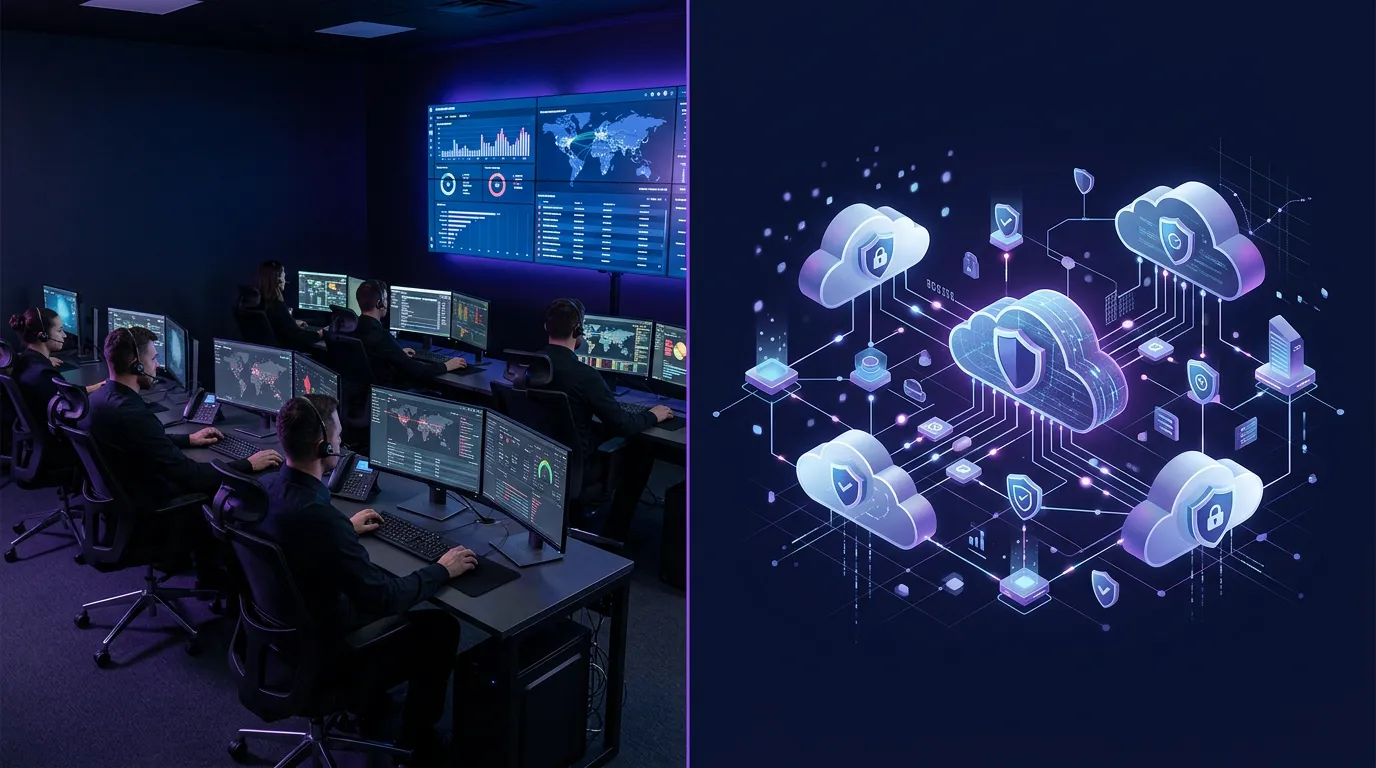
The team and technology responsible for monitoring your environment 24/7, detecting threats, and responding before damage is done. A SOC watches your logs, endpoints, network traffic, and cloud environments in real time, around the clock, including weekends and holidays.

A SOC is not your IT helpdesk, a firewall or antivirus product, or a one-time penetration test. It’s an ongoing, always-on operation.

The Real Cost of Building an In-House SOC

Here’s what a functional in-house SOC actually requires for a mid-market company (50–500 employees).

Staffing

To provide genuine 24/7 coverage, you need at minimum three shifts of analysts. A lean but functional SOC team:

RoleAnnual Salary (Toronto, 2025)
SOC Manager$110,000–$130,000
Senior SOC Analyst (×2)$85,000–$100,000 each
SOC Analyst Tier 1 (×4)$60,000–$75,000 each
Threat Intelligence Analyst$90,000–$110,000

$590K–$730K

Annual staffing cost for a lean in-house SOC, before benefits, recruitment, or turnover

Warning:

These figures don’t include benefits (typically 20–30% on top of salary), recruitment costs, or the reality that skilled security analysts have one of the highest turnover rates in tech.

Technology

A SOC requires its own dedicated toolset. At minimum:

ToolAnnual Cost
SIEM (e.g., Microsoft Sentinel, Splunk)$30,000–$120,000
EDR / XDR platform$15,000–$40,000
Threat intelligence feeds$10,000–$30,000
SOAR (automation/orchestration)$20,000–$60,000
Log storage and infrastructure$10,000–$25,000

$85K–$275K

Annual technology stack cost, tools alone, on top of staffing

Training and Certification

Security is not static. Your analysts need ongoing training, certifications (CISSP, GIAC, etc.), and threat research time. Budget $5,000–$15,000 per analyst per year, adding another $30,000–$90,000 annually.

Total In-House SOC Cost

CategoryLow EstimateHigh Estimate
Staffing$590,000$730,000
Technology$85,000$275,000
Training$30,000$90,000
Annual Total$705,000$1,095,000

$700K–$1M+

What a mid-market company spends annually on an in-house SOC, before detecting a single threat

What You Get With SOC as a Service

SOC as a Service (SOCaaS) gives you the same monitoring capability without building the infrastructure or hiring the team yourself. You pay a managed security provider for access to their analysts, tools, and processes.

  • 24/7/365 monitoring, analysts watching your environment at 2am on a Sunday, not just during business hours
  • SIEM + SOAR included, the technology stack is operated and maintained by the provider
  • Dedicated threat intelligence, updated continuously, not relying on a single analyst’s knowledge
  • Incident response support, when something is detected, the response starts immediately
  • Compliance reporting, logs and reports formatted for SOC 2, ISO 27001, NIST, and others
  • Scalability, your coverage grows with your environment without hiring

What SOCaaS Costs

ScopeMonthly CostAnnual Cost
Basic monitoring (EDR + SIEM)$3,000–$6,000$36,000–$72,000
Full SOCaaS (MDR + SOAR + IR)$6,000–$15,000$72,000–$180,000

SOCaaS is typically 5–15x less expensive than building in-house, with broader coverage, faster response times, and no hiring risk. For most mid-market companies, it’s not even close.

Side-by-Side Comparison

In-House SOCSOC as a Service
Annual cost$700K–$1M+$36K–$180K
Time to operational6–18 monthsDays to weeks
24/7 coverageDifficult to sustainIncluded
Tool costsAdditionalBundled
Staff turnover riskHighProvider’s problem
Compliance reportingManualAutomated
ScalabilitySlow and expensiveOn-demand
Threat intelligenceLimited by team sizeAggregated across all clients

When an In-House SOC Makes Sense

To be fair, there are scenarios where building internal security operations is the right call:

  • Large enterprise (1,000+ employees) with a dedicated CISO and existing security team
  • Regulated industries requiring strict data residency or air-gapped environments
  • Government and defence contractors with classified data handling requirements
  • Organizations that have already invested in a partial security team and want to build from there
Good to know:

For most mid-market companies in Toronto, professional services, manufacturing, healthcare, legal, SOCaaS is the more practical, more cost-effective path.

The Hidden Cost Nobody Talks About: Alert Fatigue

An in-house SOC dealing with hundreds or thousands of daily alerts, without the automation, playbooks, and threat intelligence context that a mature SOCaaS provider has, burns out fast. Analysts miss things. Critical alerts get buried in noise.

45%

of SOC analysts consider leaving their role due to alert fatigue, and average breach detection time without mature capabilities is still over 200 days

The cost of a missed breach isn’t just remediation. It’s regulatory penalties, client notification requirements, reputational damage, and downtime. That number dwarfs any savings from going in-house.

What to Look for in a SOC as a Service Provider

Not all providers are equal. When evaluating SOCaaS, ask:

What is your mean time to detect (MTTD) and mean time to respond (MTTR)? Get SLA numbers in writing.

Do you have dedicated analysts or shared pools? Shared analysts across hundreds of clients is not the same as dedicated coverage.

What tools do you use? A reputable provider will be transparent about their SIEM, EDR, and SOAR stack.

How do you handle incident response? Detection alone isn’t enough, response capability matters.

Can you support our compliance requirements? SOC 2, ISO 27001, NIST, PHIPA, confirm they have experience with your specific framework.

What does onboarding look like? Time-to-value matters. A 6-month onboarding is a red flag.

Bottom Line

For mid-market companies in Toronto and the GTA, the math on building an in-house SOC rarely works out. The staffing cost alone exceeds what most businesses spend on IT entirely, and sustaining 24/7 coverage without burnout or gaps is genuinely hard to do at this scale.

SOC as a Service gives you enterprise-grade detection and response at a fraction of the cost, with faster deployment and no hiring risk. If you’re evaluating your security posture, or if a cyber insurance renewal has put this decision on your plate, it’s worth having a conversation.

Talk to BALANCED+ about managed SOC and security operations →

MDR vs. EDR vs. XDR: What’s the Difference?

Your security vendor says you need EDR. Your consultant recommends MDR. The latest analyst report says XDR is the future. Meanwhile, you just need to know your business is protected and you are not overpaying for capabilities you will never use.

These three acronyms represent fundamentally different approaches to threat detection and response. Choosing the wrong one does not just waste budget, it leaves gaps that attackers know how to exploit. Here is what each one actually does, where they overlap, and how to pick the right fit for your organization.

EDR is a tool that protects endpoints. MDR is a managed service where experts monitor and respond on your behalf. XDR is a platform that correlates data across your entire environment. Most mid-market businesses get the best results from MDR paired with strong EDR, not by chasing the newest acronym.

EDR: The Foundation of Endpoint Security

EDR (Endpoint Detection and Response)

Software installed on endpoints, laptops, servers, workstations, that continuously monitors for suspicious activity, records telemetry, and can isolate threats in real time. Think of it as a security camera with a panic button on every device.

EDR replaced traditional antivirus for a reason. Legacy antivirus relies on known malware signatures, a database of known bad files. EDR watches behavior. It does not just ask “is this file on the blocklist?” It asks “why is PowerShell launching at 3 AM and trying to reach an external IP?”

What EDR Does Well

EDR excels at catching threats that bypass traditional defenses. Fileless malware that lives in memory, legitimate tools being used maliciously (known as living-off-the-land attacks), and ransomware that encrypts files faster than signature-based tools can react. Modern EDR platforms provide real-time visibility into what is happening on every endpoint, detailed forensic timelines when something goes wrong, and automated containment to isolate a compromised device before the threat spreads.

68%

of breaches involve a human element like phishing or stolen credentials, exactly the endpoint-level threats EDR is designed to catch. (Verizon DBIR 2024)

Where EDR Falls Short

EDR only sees endpoints. If an attacker compromises a cloud application, moves laterally through your identity provider, or exploits a network vulnerability, your EDR may never fire an alert. It is one lens on a complex environment.

The bigger problem: EDR generates a massive volume of alerts. A 200-endpoint deployment can produce thousands of events daily. Without skilled analysts triaging those alerts, real threats get buried in noise. This is where most organizations hit the wall, they buy EDR expecting it to solve the problem, then realize they do not have anyone to watch it.

Warning:

Deploying EDR without dedicated staff to monitor it is like installing a fire alarm system with nobody to answer the calls. The technology works, but only if someone is paying attention.

MDR: Expert Eyes on Your Environment

MDR (Managed Detection and Response)

A fully managed security service where a team of analysts monitors your environment 24/7, investigates alerts, hunts for threats proactively, and responds to incidents on your behalf. MDR is not a product, it is a team you hire.

MDR exists because most businesses cannot staff a security operations center. Hiring a single senior security analyst in Canada costs well over $100,000 per year. A proper 24/7 SOC requires a minimum of five to six analysts working in shifts, plus tooling, training, and management overhead. For a mid-market company, that math rarely works.

MDR providers solve this by spreading that cost across many clients while maintaining the expertise and coverage that each individual client needs.

What MDR Actually Includes

A strong MDR service goes far beyond alert forwarding. The core capabilities you should expect include continuous 24/7 monitoring and triage of security events, proactive threat hunting to find attackers who have evaded automated defenses, guided or fully managed incident response when threats are confirmed, regular reporting on your security posture and risk trends, and access to senior analysts who understand your environment, not just a rotating help desk.

Where MDR Falls Short

MDR providers are only as effective as the data they can see. Most MDR services are built around EDR telemetry, endpoint data. If your network, cloud, email, and identity systems are not feeding into the MDR platform, threats in those layers can go undetected. Some advanced MDR providers integrate broader data sources, but this varies significantly between vendors.

There is also a dependency factor. Your MDR provider becomes a critical part of your security posture. If their SOC is overwhelmed, understaffed, or using outdated detection logic, your risk increases without your knowledge.

XDR: The Unified Platform

XDR (Extended Detection and Response)

A security platform that ingests and correlates telemetry from multiple sources, endpoints, network, cloud workloads, email, and identity systems, into a single detection and response layer. XDR aims to eliminate the silos between security tools.

XDR emerged because modern attacks do not stay in one lane. A typical breach might start with a phishing email, use stolen credentials to access a cloud application, move laterally through your identity provider, and ultimately deploy ransomware on endpoints. EDR only sees the last step. A SIEM might see the pieces individually but struggle to connect them. XDR is designed to correlate the full kill chain automatically.

What XDR Does Well

The core advantage of XDR is visibility and correlation. Instead of security analysts manually pivoting between six different consoles, XDR brings everything into one view. An endpoint alert becomes meaningful when correlated with a suspicious login from an unfamiliar location, an unusual email rule creation, and a spike in data exfiltration from OneDrive, all within the same ten-minute window.

Where XDR Falls Short

XDR is a platform, not a team. It gives you the tools and the data, but someone still needs to interpret the output, investigate alerts, and execute the response. Many organizations that deploy XDR discover they still need MDR-level expertise to operate it effectively.

There is also the vendor lock-in concern. Most XDR platforms work best, or only work, with the vendor’s own security stack. If you are running Fortinet firewalls, Microsoft 365 for email, and CrowdStrike for endpoints, no single XDR platform will natively ingest all three without significant integration effort.

Good to know:

XDR is gaining traction among enterprises with mature security operations. For mid-market businesses without a dedicated security team, XDR often delivers the most value when it is operated by an MDR provider, giving you the platform visibility with the provider expertise.

Head-to-Head: EDR vs. MDR vs. XDR

EDRMDRXDR
What it isSoftware (tool)Managed service (team)Platform (integrated tool)
CoverageEndpoints onlyDepends on data sourcesEndpoints, network, cloud, email, identity
Who operates itYour internal teamExternal security analystsYour team or an MDR provider
24/7 monitoringOnly if you staff itYes, includedOnly if you staff it
Threat huntingNoYes, proactiveDepends on implementation
Incident responseAutomated containmentHuman-led responseAutomated + manual
Best forTeams with in-house security staffBusinesses without a SOCMature security programs
Typical cost$$$$$$$–$$$$

How to Choose: A Decision Framework

The right answer depends on three factors: your internal security capabilities, your environment complexity, and your risk tolerance.

Assess Your Internal Security Capacity

Do you have dedicated security staff who can monitor, investigate, and respond to alerts during business hours and after hours? If the answer is no, and for most mid-market businesses it is, you need a managed component. EDR alone will not be enough.

Map Your Attack Surface

If your environment is primarily on-premises with traditional endpoints, EDR covers the majority of your risk. If you are running a hybrid environment with cloud workloads, SaaS applications, remote workers, and multiple identity systems, you need visibility beyond the endpoint.

Define Your Response Expectations

When a real threat is detected at 2 AM, what do you need to happen? If you expect automated containment and a ticket for your team to review in the morning, EDR may suffice. If you expect a trained analyst to investigate, contain the threat, and brief your leadership, you need MDR.

Evaluate Vendor Lock-in and Integration

If you are already invested in a specific security ecosystem, for example, Fortinet for network security and Microsoft for productivity, check whether an XDR platform can actually ingest all your data sources. If integration is limited, an MDR provider with a vendor-agnostic approach may deliver better visibility.

The Most Common Mistake We See

Organizations buy EDR, deploy it to all endpoints, and assume they are covered. Six months later, they discover the alerts have been piling up unreviewed, the automated containment was never properly tuned, and the only reason they found out about a real threat is because a user noticed their files were encrypted.

78%

of organizations say they lack the in-house skills to fully operate their security tools. The tools are not the bottleneck, staffing is. (ISC2 Cybersecurity Workforce Study)

This is not a technology failure. It is an expectations failure. EDR is the engine, but without a driver, whether internal staff or an MDR provider, it idles.

What Most Mid-Market Businesses Actually Need

For the majority of mid-market Canadian businesses, 50 to 500 employees, hybrid cloud environments, limited internal security resources, the sweet spot is MDR with strong EDR as the foundation.

This gives you endpoint-level detection and containment through EDR, 24/7 human monitoring and investigation through MDR, proactive threat hunting that catches what automation misses, and incident response capabilities without the cost of building an internal SOC.

XDR becomes relevant when your environment is complex enough to justify the platform investment and when you have either internal staff or an MDR provider capable of operating it. For most mid-market organizations, XDR-level visibility is better achieved through an MDR provider that integrates multiple data sources than by deploying and managing an XDR platform internally.

Questions to Ask Before You Buy

Whether you are evaluating EDR, MDR, or XDR, these questions will cut through vendor marketing and reveal what you are actually getting.

For EDR vendors: What is the average time to detect and contain a threat? What happens when an alert fires after hours? How many alerts does a typical deployment generate, and what is the false positive rate?

For MDR providers: What is your mean time to respond to a confirmed threat? Do your analysts actively contain threats, or do they only notify us? What data sources do you monitor beyond endpoints? Can I speak to a senior analyst, or only a help desk?

For XDR platforms: Which data sources are natively supported? What integration effort is required for tools outside your ecosystem? Do I need dedicated staff to operate the platform, or is managed operation available?

Making the Right Call

The cybersecurity vendor landscape wants you to believe that each new acronym replaces the last. It does not. EDR, MDR, and XDR are complementary layers, not competing products. The right combination depends on your team, your environment, and the level of risk your business can tolerate.

Start with what you can actually operate. A well-managed EDR deployment with an MDR service behind it will outperform an expensive XDR platform that nobody is watching. Security is not a product you buy, it is a capability you build.

If you are evaluating detection and response solutions for your organization and want a straightforward assessment of what you actually need, learn more about our MDR service or explore our EDR capabilities. We will tell you what fits, even if the answer is simpler than you expected.