If your business has been hit with a cybersecurity assessment or a new insurance renewal, you’ve probably landed on the same question: do we build our own Security Operations Center, or do we outsource it?
It sounds like a straightforward build-vs-buy decision. It’s not. The real numbers are rarely shared, and the gap between what an in-house SOC costs and what most mid-market businesses can actually sustain is significant.
This post breaks it down honestly.
What Is a SOC?
Security Operations Center (SOC)
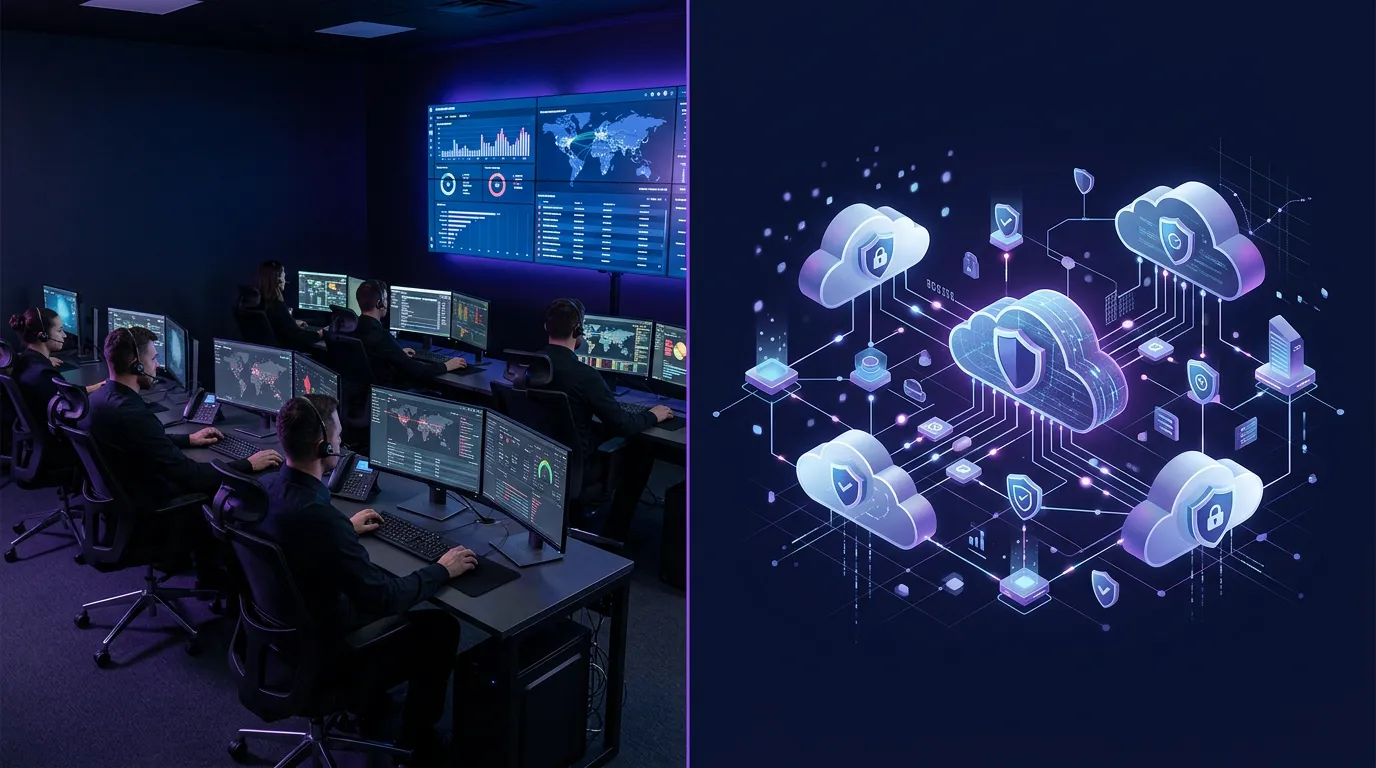
The team and technology responsible for monitoring your environment 24/7, detecting threats, and responding before damage is done. A SOC watches your logs, endpoints, network traffic, and cloud environments in real time, around the clock, including weekends and holidays.
A SOC is not your IT helpdesk, a firewall or antivirus product, or a one-time penetration test. It’s an ongoing, always-on operation.
The Real Cost of Building an In-House SOC
Here’s what a functional in-house SOC actually requires for a mid-market company (50–500 employees).
Staffing
To provide genuine 24/7 coverage, you need at minimum three shifts of analysts. A lean but functional SOC team:
| Role | Annual Salary (Toronto, 2025) |
|---|---|
| SOC Manager | $110,000–$130,000 |
| Senior SOC Analyst (×2) | $85,000–$100,000 each |
| SOC Analyst Tier 1 (×4) | $60,000–$75,000 each |
| Threat Intelligence Analyst | $90,000–$110,000 |
$590K–$730K
Annual staffing cost for a lean in-house SOC, before benefits, recruitment, or turnover
These figures don’t include benefits (typically 20–30% on top of salary), recruitment costs, or the reality that skilled security analysts have one of the highest turnover rates in tech.
Technology
A SOC requires its own dedicated toolset. At minimum:
| Tool | Annual Cost |
|---|---|
| SIEM (e.g., Microsoft Sentinel, Splunk) | $30,000–$120,000 |
| EDR / XDR platform | $15,000–$40,000 |
| Threat intelligence feeds | $10,000–$30,000 |
| SOAR (automation/orchestration) | $20,000–$60,000 |
| Log storage and infrastructure | $10,000–$25,000 |
$85K–$275K
Annual technology stack cost, tools alone, on top of staffing
Training and Certification
Security is not static. Your analysts need ongoing training, certifications (CISSP, GIAC, etc.), and threat research time. Budget $5,000–$15,000 per analyst per year, adding another $30,000–$90,000 annually.
Total In-House SOC Cost
| Category | Low Estimate | High Estimate |
|---|---|---|
| Staffing | $590,000 | $730,000 |
| Technology | $85,000 | $275,000 |
| Training | $30,000 | $90,000 |
| Annual Total | $705,000 | $1,095,000 |
$700K–$1M+
What a mid-market company spends annually on an in-house SOC, before detecting a single threat
What You Get With SOC as a Service
SOC as a Service (SOCaaS) gives you the same monitoring capability without building the infrastructure or hiring the team yourself. You pay a managed security provider for access to their analysts, tools, and processes.
- 24/7/365 monitoring, analysts watching your environment at 2am on a Sunday, not just during business hours
- SIEM + SOAR included, the technology stack is operated and maintained by the provider
- Dedicated threat intelligence, updated continuously, not relying on a single analyst’s knowledge
- Incident response support, when something is detected, the response starts immediately
- Compliance reporting, logs and reports formatted for SOC 2, ISO 27001, NIST, and others
- Scalability, your coverage grows with your environment without hiring
What SOCaaS Costs
| Scope | Monthly Cost | Annual Cost |
|---|---|---|
| Basic monitoring (EDR + SIEM) | $3,000–$6,000 | $36,000–$72,000 |
| Full SOCaaS (MDR + SOAR + IR) | $6,000–$15,000 | $72,000–$180,000 |
SOCaaS is typically 5–15x less expensive than building in-house, with broader coverage, faster response times, and no hiring risk. For most mid-market companies, it’s not even close.
Side-by-Side Comparison
| In-House SOC | SOC as a Service | |
|---|---|---|
| Annual cost | $700K–$1M+ | $36K–$180K |
| Time to operational | 6–18 months | Days to weeks |
| 24/7 coverage | Difficult to sustain | Included |
| Tool costs | Additional | Bundled |
| Staff turnover risk | High | Provider’s problem |
| Compliance reporting | Manual | Automated |
| Scalability | Slow and expensive | On-demand |
| Threat intelligence | Limited by team size | Aggregated across all clients |
When an In-House SOC Makes Sense
To be fair, there are scenarios where building internal security operations is the right call:
- Large enterprise (1,000+ employees) with a dedicated CISO and existing security team
- Regulated industries requiring strict data residency or air-gapped environments
- Government and defence contractors with classified data handling requirements
- Organizations that have already invested in a partial security team and want to build from there
For most mid-market companies in Toronto, professional services, manufacturing, healthcare, legal, SOCaaS is the more practical, more cost-effective path.
The Hidden Cost Nobody Talks About: Alert Fatigue
An in-house SOC dealing with hundreds or thousands of daily alerts, without the automation, playbooks, and threat intelligence context that a mature SOCaaS provider has, burns out fast. Analysts miss things. Critical alerts get buried in noise.
45%
of SOC analysts consider leaving their role due to alert fatigue, and average breach detection time without mature capabilities is still over 200 days
The cost of a missed breach isn’t just remediation. It’s regulatory penalties, client notification requirements, reputational damage, and downtime. That number dwarfs any savings from going in-house.
What to Look for in a SOC as a Service Provider
Not all providers are equal. When evaluating SOCaaS, ask:
What is your mean time to detect (MTTD) and mean time to respond (MTTR)? Get SLA numbers in writing.
Do you have dedicated analysts or shared pools? Shared analysts across hundreds of clients is not the same as dedicated coverage.
What tools do you use? A reputable provider will be transparent about their SIEM, EDR, and SOAR stack.
How do you handle incident response? Detection alone isn’t enough, response capability matters.
Can you support our compliance requirements? SOC 2, ISO 27001, NIST, PHIPA, confirm they have experience with your specific framework.
What does onboarding look like? Time-to-value matters. A 6-month onboarding is a red flag.
Bottom Line
For mid-market companies in Toronto and the GTA, the math on building an in-house SOC rarely works out. The staffing cost alone exceeds what most businesses spend on IT entirely, and sustaining 24/7 coverage without burnout or gaps is genuinely hard to do at this scale.
SOC as a Service gives you enterprise-grade detection and response at a fraction of the cost, with faster deployment and no hiring risk. If you’re evaluating your security posture, or if a cyber insurance renewal has put this decision on your plate, it’s worth having a conversation.
Talk to BALANCED+ about managed SOC and security operations →