Skip to content

Tips for Scaling Your Fortigate

The Growth Paradox: Scaling Your Business Can Strain Your Security

The excitement of business growth is undeniable. More customers, more employees, more data, more locations it all points to success. Yet, this very growth often presents a hidden challenge for your IT infrastructure, particularly your network security. What happens when your security solution, once perfectly adequate, can no longer keep pace?

An improperly designed or unscalable FortiGate architecture can quickly transform from a powerful protector into a critical bottleneck. This can lead to frustrating performance degradation, increased management complexity, and, most dangerously, new security vulnerabilities that expose your expanding operations to unnecessary risk. Don’t let your security become the barrier to your next big leap.

Recognizing FortiGate Scalability Issues in Your Network

How can you tell if your current FortiGate deployment is struggling to keep up with your business growth? Look for these common symptoms of FortiGate scalability issues:

  • Network Slowdowns and Latency: Users complain about sluggish application performance, slow internet access, or delays in accessing internal resources, especially during peak hours.
  • Frequent CPU/Memory Spikes: Your FortiGate devices consistently show high CPU or memory utilization, even during what should be normal operational periods, indicating they are being overworked.
  • Management Complexity Overload: It becomes increasingly difficult to manage a growing number of security policies, VPN tunnels, or user access rules, leading to errors and inefficiencies.
  • Challenges with New Integrations: Integrating new cloud services, opening new branch offices, or onboarding a large number of remote users becomes a painful, performance-impacting process.
  • Increased Operational Costs: You might be overspending on bandwidth or other resources to compensate for an underperforming security appliance, or constantly troubleshooting issues that stem from architectural limitations.

If any of these sound familiar, it’s a strong indicator that your FortiGate architecture needs a strategic review.

Common FortiGate Scalability Pitfalls to Avoid

Many businesses inadvertently create FortiGate scalability issues by overlooking key planning considerations:

  • Under-Sizing from the Start: Choosing a FortiGate model based only on current needs, without forecasting future growth in user count, traffic volume, or the adoption of new bandwidth-intensive applications.
  • Monolithic Design: Relying on a single FortiGate device to handle all security functions for an entire, rapidly expanding organization. This creates a single point of failure and can easily overwhelm the device’s capacity.
  • Lack of Network Segmentation: As your network grows, failing to properly segment it into smaller, isolated zones. This increases the “blast radius” of a potential breach and makes policy management unwieldy.
  • Inefficient Policy Management: Allowing your security policy database to become a sprawling, unoptimized mess. Too many redundant or overly broad rules can significantly impact FortiGate performance.
  • Ignoring Cloud Integration: Neglecting to plan for secure, scalable integration with public or private cloud resources and SaaS applications as your business increasingly adopts them.

Designing for Growth: Key Principles for FortiGate Scalability

Addressing FortiGate scalability issues requires a proactive and strategic approach. Here are the core principles for designing a FortiGate deployment that truly grows with your business:

  • Strategic Sizing & Forecasting: Always select FortiGate models with ample headroom. Work with experts to forecast your expected growth (e.g., 3-5 years out) in users, devices, traffic, and security feature usage to ensure your chosen appliances can handle future demands.
  • High Availability (HA) & Redundancy: Implement FortiGate devices in High Availability (HA) clusters (active-passive or active-active). This not only ensures business continuity in case of a device failure but also allows for better load distribution and seamless upgrades.
  • Network Segmentation & Micro-segmentation: Break down your network into smaller, isolated zones using FortiGate’s Virtual Domains (VDOMs) or internal segmentation firewall capabilities. This limits the lateral movement of threats and simplifies policy management for specific user groups or applications.
  • Leveraging FortiManager & FortiAnalyzer: For growing and complex deployments, these centralized management and analytics platforms are non-negotiable.
    • FortiManager provides unified policy orchestration across multiple FortiGates, simplifying configuration and ensuring consistency.
    • FortiAnalyzer offers scalable logging, advanced analytics, and threat intelligence, crucial for monitoring performance and identifying emerging threats across your expanded network.
  • Secure SD-WAN for Distributed Environments: If your business has multiple branch offices or a significant remote workforce, FortiGate’s integrated Secure SD-WAN capabilities are vital. They efficiently and securely connect distributed environments, optimizing application performance across diverse connections and reducing reliance on expensive MPLS lines.
  • Cloud-Native Integration (FortiGate-VM): For businesses embracing cloud infrastructure, deploy FortiGate-VM (Virtual Machines). This extends consistent FortiGate security policies and centralized management into public and private cloud environments, ensuring seamless scalability and protection for your cloud workloads.

Don’t Let Your Security Become a Barrier to Growth.

The journey of business expansion is exciting, but it shouldn’t be hampered by an outdated or unscalable security infrastructure. Proactive planning for FortiGate scalability issues is an investment in your future success, ensuring that your network security evolves in lockstep with your business ambitions.

Partner with BALANCED+ for Future-Proof FortiGate Architecture.

At BALANCED+, we understand the unique challenges growing businesses face. Our experts specialize in designing, implementing, and optimizing FortiGate solutions that are built for tomorrow’s demands, not just today’s.

Is your FortiGate ready for your business’s next growth phase? Ensure your security scales with your success. BALANCED+ specializes in FortiGate architecture review and scalability planning. Schedule a consultation with our experts to future-proof your network security.

FortiGate Cloud Optimization: Boost VM Performance

Your Cloud Infrastructure Demands More Than Just Basic Security.

As businesses increasingly migrate to cloud environments, the traditional security perimeter dissolves, creating new challenges and opportunities for protection. Simply lifting and shifting on-premises security solutions won’t suffice. To ensure robust defense and efficient operations in public or private clouds, a purpose-built virtual firewall like FortiGate-VM is not just an option, but an essential component for consistent security across hybrid and multi-cloud architectures.

Why FortiGate-VM for Cloud Security?

Extending your security posture into the cloud requires a solution that’s as agile and scalable as the cloud itself. FortiGate-VM brings the full power of FortiGate’s advanced security features directly into your cloud infrastructure:

  • Comprehensive Security: Leverage Next-Generation Firewall (NGFW) capabilities, Unified Threat Management (UTM) services (like IPS, antivirus, web filtering, application control), and integrated Secure SD-WAN directly within your cloud deployments.
  • Consistency and Centralization: Maintain consistent security policies and management across your on-premises FortiGate devices and your cloud-based FortiGate-VM instances, often managed from a single pane of glass (e.g., FortiManager).
  • Scalability and Flexibility: Easily scale your security resources up or down to match cloud workload demands, paying only for what you use, a core principle of effective FortiGate Cloud Optimization.

Critical Considerations for FortiGate-VM Deployment

Effective FortiGate Cloud Optimization begins with thoughtful deployment planning.

Right-Sizing Your FortiGate-VM

Choosing the correct virtual machine instance type and resource allocation (vCPUs, RAM) is paramount. It’s not a one-size-fits-all. Consider:

  • Expected Traffic Volume: How much data will flow through the FortiGate-VM?
  • Security Profiles Enabled: Will you be using deep packet inspection (SSL/TLS inspection), IPS, or other resource-intensive features?
  • Throughput Requirements: Match the chosen FortiGate-VM model (e.g., FortiGate-VM01, VM02, VM04) to your desired throughput, ensuring it aligns with your cloud provider’s instance capabilities. Over-provisioning wastes resources, under-provisioning creates bottlenecks.

Network Architecture Design

Integrating FortiGate-VM seamlessly into your cloud network requires careful design:

  • Virtual Private Clouds (VPCs) / Virtual Networks: Position FortiGate-VM strategically within your cloud VPCs to act as a security gateway for traffic entering and leaving your protected subnets.
  • Subnets and Routing: Configure subnets and routing tables to direct relevant traffic through the FortiGate-VM for inspection and policy enforcement. This is crucial for ensuring all desired traffic is secured.

Licensing Models

Understand the licensing options for FortiGate-VM in the cloud:

  • Bring Your Own License (BYOL): If you have existing FortiGate licenses, you might be able to use them in the cloud.
  • Pay-as-you-go (On-Demand): Cloud marketplaces often offer FortiGate-VM as a service, billed hourly or monthly, which can be ideal for flexible scaling and cost management. Choosing the right model is key for FortiGate Cloud Optimization from a financial perspective.

Best Practices for FortiGate-VM Configuration & Performance

Once deployed, optimizing your FortiGate-VM‘s configuration is vital for peak performance and security.

Resource Allocation & Performance Features

  • Cloud-Native Network Features: Leverage cloud provider-specific network enhancements (e.g., SR-IOV in Azure, Enhanced Networking in AWS, or equivalent features) to boost throughput and reduce latency for your virtual network interfaces.
  • Virtual Network Interface Sizing: Ensure your virtual network interfaces are appropriately sized and configured to handle expected traffic loads.

Policy Optimization

  • Granular Security Policies: Create specific, granular security policies that define exactly what traffic is allowed or denied. Avoid broad “any/any” rules, which can increase processing overhead and security risks.
  • Policy Ordering: Place the most frequently hit or most specific policies at the top of your rule base for faster processing.

Security Profile Tuning

  • Balance Efficacy and Performance: While enabling all security profiles offers maximum protection, it also consumes more resources. Tune IPS, Antivirus, Web Filtering, and Application Control profiles to balance security efficacy with performance impact, focusing on the most critical threats for your environment.
  • Exclusions: Implement judicious exclusions for trusted traffic or applications that don’t require deep inspection, but do so cautiously.

Logging & Monitoring

  • Robust Logging: Configure your FortiGate-VM to send comprehensive logs to a centralized FortiAnalyzer instance (whether in the cloud or on-premises). This is critical for security analytics, troubleshooting, and FortiGate Threat Hunting.
  • Continuous Monitoring: Regularly monitor your FortiGate-VM’s performance metrics (CPU utilization, memory usage, session count, throughput) using cloud provider monitoring tools and FortiGate dashboards to identify and address bottlenecks proactively.

High Availability (HA) in the Cloud

For business continuity and resilience, deploy FortiGate-VM in High Availability (HA) configurations. Cloud providers offer mechanisms to support active-passive or active-active HA setups, ensuring your security gateway remains operational even if an instance fails.

SD-WAN for Cloud Connectivity

Leverage FortiGate-VM‘s integrated Secure SD-WAN capabilities to optimize connectivity to SaaS applications, other cloud resources, and distributed branches. This improves user experience, reduces latency, and provides intelligent path selection for critical business traffic.

Cloud-Specific Security Integrations

  • Cloud-Native Security Services: Integrate FortiGate-VM with cloud-native security services like security groups, network access control lists (NACLs), and Identity and Access Management (IAM) roles to create a layered, defense-in-depth strategy.
  • Auto-Scaling: Explore options for auto-scaling FortiGate-VM instances based on demand, ensuring performance scales dynamically with your cloud workloads.

The BALANCED+ Advantage in FortiGate Cloud Optimization

Optimizing FortiGate-VM in complex cloud environments requires specialized expertise. BALANCED+ is your trusted partner in maximizing your FortiGate investment and ensuring robust cloud security. We can assist your business with:

  • Strategic Planning and Design: Expertly architecting your FortiGate-VM deployments for optimal security and performance.
  • Expert Configuration and Performance Tuning: Fine-tuning your FortiGate-VM instances for peak efficiency and security efficacy.
  • Ongoing Managed Services: Providing continuous monitoring, maintenance, and threat intelligence for your cloud security infrastructure.
  • Guidance on Cloud Security Best Practices: Ensuring your cloud environment adheres to the highest security standards and compliance requirements.

Don’t let the complexities of cloud security compromise your business. With proper FortiGate Cloud Optimization, you can achieve powerful, scalable, and efficient protection for your cloud-based assets.

Ready to boost your FortiGate-VM performance in the cloud?

Contact BALANCED+ today for a consultation and discover how we can help you achieve seamless FortiGate Cloud Optimization and robust security.

FortiGate Threat Hunting: From Logs to Insights

The Silence from Your Security Tools Can Be the Loudest Warning.

Relying solely on automated alerts and waiting for a breach to trigger a response is a dangerous gamble. In an era of increasingly sophisticated cyber threats, a reactive security posture leaves your organization vulnerable to advanced persistent threats (APTs) and stealthy attacks that bypass traditional defenses. To truly protect your digital assets, businesses must shift from simply reacting to actively seeking out hidden dangers. This is where FortiGate Threat Hunting becomes indispensable, transforming your security logs from mere records into a powerful weapon.

FortiGate: Your Foundation for Rich Security Data

Your FortiGate devices are more than just firewalls; they are powerful data collection engines. Every packet, every connection, every security event generates valuable logs that paint a detailed picture of your network’s activity. This vast amount of dataencompassing traffic flows, security events, user behavior, and application usageforms the essential foundation for effective FortiGate Threat Hunting. It’s the raw material from which insights are forged, allowing you to uncover anomalies and suspicious patterns that automated systems might miss.

What Exactly is Threat Hunting?

Threat hunting is the proactive, iterative search through network data to detect and isolate advanced threats that have evaded existing security solutions. Unlike traditional security, which waits for an alert, threat hunting assumes a breach has occurred or is in progress. It involves security analysts actively looking for subtle indicators of compromise (IOCs) or unusual behaviors that suggest malicious activity. It’s about asking “what if?” and systematically investigating those hypotheses using the rich data at your fingertips.

The Indispensable Role of FortiGate Logs in Threat Hunting

FortiGate devices generate a wealth of log data, each type offering unique insights for FortiGate Threat Hunting:

  • Traffic Logs: Detail every connection, including source/destination IP, ports, protocols, and bandwidth. Crucial for identifying unusual communication patterns or data exfiltration.
  • UTM Logs: Record events from unified threat management features like IPS, antivirus, web filtering, and application control. Helps pinpoint blocked threats and policy violations.
  • Event Logs: Capture system-level events, configuration changes, and administrative activities, essential for detecting unauthorized access or tampering.
  • VPN Logs: Provide visibility into remote access and site-to-site VPN connections, vital for monitoring secure access and identifying suspicious login attempts.

By analyzing these diverse log types, security teams gain comprehensive visibility into network behavior, allowing them to spot potential anomalies and subtle indicators that a threat might be present.

Leveraging FortiAnalyzer and FortiManager for Advanced FortiGate Threat Hunting

While FortiGate devices generate the data, tools like FortiAnalyzer and FortiManager elevate your FortiGate Threat Hunting capabilities to the next level.

  • FortiAnalyzer: This centralized logging, analysis, and reporting platform is critical for aggregating and correlating log data from multiple FortiGate devices. It provides:
    • Centralized Visibility: A single pane of glass for all your FortiGate logs.
    • Log Correlation: Identifies relationships between seemingly disparate events, uncovering complex attack chains.
    • Custom Reports & Dashboards: Allows security teams to create tailored views of their data, highlighting specific metrics or potential threats.
    • Automated Playbooks: Can be configured to automate responses to detected anomalies, speeding up incident response.
  • FortiManager: While primarily for centralized management and orchestration of FortiGate devices, FortiManager also aids threat hunting by ensuring consistent security policies and simplifying the deployment of new rules based on threat intelligence gathered during hunting exercises.

Together, these platforms empower security analysts to move beyond basic log review, enabling sophisticated data analysis and pattern recognition crucial for effective FortiGate Threat Hunting.

Practical Steps for FortiGate Threat Hunting

So, how do you put FortiGate Threat Hunting into practice? Here are some actionable scenarios:

  1. Investigating Unusual Outbound Traffic: Look for large data transfers to unknown external IPs, especially during off-hours. This could indicate data exfiltration.
  2. Analyzing Failed Login Attempts: Identify a high volume of failed login attempts from unusual geographic locations or against specific user accounts, potentially signaling a brute-force attack.
  3. Detecting Unauthorized Application Usage: Use application control logs to find employees using unsanctioned applications that might pose a security risk or violate company policy.
  4. Correlating Disparate Alerts: Combine seemingly minor alerts (e.g., a single malware detection, followed by unusual network activity from the same host) to uncover a larger, more coordinated attack.
  5. Searching for Known Indicators of Compromise (IOCs): Proactively search your logs for known malicious IP addresses, domains, or file hashes provided by threat intelligence feeds.

The Undeniable Benefits of Proactive FortiGate Threat Hunting

Embracing FortiGate Threat Hunting offers significant advantages for your business:

  • Early Detection of Advanced Threats: Uncover sophisticated attacks like APTs that are designed to bypass traditional perimeter defenses.
  • Reduced Dwell Time: Minimize the time attackers spend undetected within your network, significantly reducing potential damage.
  • Minimized Breach Impact: By identifying threats early, you can contain them before they escalate into major security incidents.
  • Improved Overall Security Posture: Continuously refine your defenses by understanding how attackers are attempting to breach your systems.
  • Deeper Network Understanding: Gain unparalleled visibility into your network’s normal behavior, making anomalies easier to spot.

Partnering with BALANCED+ for Expert FortiGate Threat Hunting

While the power of FortiGate analytics is immense, effectively leveraging it for proactive threat hunting requires expertise and dedicated resources. BALANCED+ is your trusted partner in maximizing your FortiGate investment. We can help your business:

  • Optimize FortiGate Logging and Reporting: Ensure your devices are configured to capture the most relevant data.
  • Implement and Configure FortiAnalyzer/FortiManager: Set up these critical platforms for centralized visibility and analysis.
  • Provide Managed Threat Hunting Services: Our security experts can conduct proactive threat hunts on your behalf, identifying and neutralizing threats before they cause harm.
  • Offer Training and Expertise: Empower your internal team with the knowledge to perform effective FortiGate Threat Hunting.

Don’t let hidden threats compromise your business. Move beyond reactive security and embrace the proactive power of FortiGate Threat Hunting.

Ready to transform your security logs into actionable intelligence?

Contact BALANCED+ today for a consultation and discover how we can help you fortify your defenses with advanced FortiGate Threat Hunting capabilities.

Is Your FortiGate Underperforming? How a Managed Service Can Optimize It

Is your network feeling sluggish? Are users complaining about slow application response times, or are you noticing delays in your critical business processes? If you’re relying on a FortiGate firewall, an underperforming device could be the silent culprit. While FortiGate appliances are powerful security solutions, a slow FortiGate firewall isn’t just an annoyance it’s a potential security risk and a drag on your business’s productivity.

Many organizations invest in top-tier security like FortiGate, only to find it doesn’t quite live up to its full potential. The good news is, you don’t have to settle for “good enough.” A specialized managed service can be the game-changer you need to optimize FortiGate performance and ensure your network is both fast and secure.

Why Your FortiGate Might Be Dragging Its Feet

Before diving into solutions, let’s understand why your FortiGate might be underperforming. It’s often not the hardware itself, but how it’s configured and maintained. Common culprits include:

  • Improper Configuration: Out-of-the-box settings are rarely optimized for unique business needs. Overly complex or redundant firewall rules, inefficient routing, or misconfigured security profiles (like IPS, antivirus, or web filtering) can choke performance.
  • Outdated Firmware: Running older firmware versions can lead to performance bottlenecks, missing critical bug fixes, and a lack of access to the latest optimizations.
  • Resource Bottlenecks: High CPU or memory utilization, especially during peak traffic, indicates that your FortiGate might be struggling to keep up with the demands placed upon it.
  • Excessive Logging: While essential for security, overly granular logging can consume significant resources and storage, slowing down the device.
  • Inefficient Security Policies: Broad “allow all” rules, or a sheer volume of unoptimized rules, force the FortiGate to work harder than necessary to process traffic.
  • Unmanaged Growth: As your network expands and traffic patterns change, your initial FortiGate setup might no longer be adequate without continuous adjustments.

The Power of a Managed Service: Your FortiGate Performance Partner

This is where a dedicated managed service provider (MSP) steps in. They’re not just reacting to problems; they’re proactively managing, monitoring, and optimizing your FortiGate to prevent issues before they impact your operations.

Here’s how a managed service can help optimize FortiGate performance:

Expert Configuration & FortiGate Best Practices

One of the primary benefits of an MSP is their deep expertise in FortiGate best practices. They understand the intricacies of FortiOS and can fine-tune your appliance for optimal speed and security. This includes:

  • Rule Set Optimization: Streamlining firewall policies, removing redundant or shadowed rules, and ordering them efficiently to minimize processing time.
  • UTM/Security Profile Tuning: Configuring Intrusion Prevention Systems (IPS), Application Control, Web Filtering, and Antivirus settings to provide robust security without unnecessary overhead.
  • VPN Performance: Optimizing VPN tunnels for maximum throughput and stability.
  • Routing & SD-WAN Optimization: Ensuring traffic takes the most efficient path, especially critical for multi-site organizations.

Proactive Monitoring & Troubleshooting

A slow FortiGate firewall often gives subtle hints before a complete meltdown. MSPs employ advanced monitoring tools to keep a constant eye on your FortiGate’s health. They track key metrics like CPU and memory utilization, session counts, interface throughput, and log data. This allows them to:

  • Identify Bottlenecks: Pinpoint exactly where performance issues are originating, whether it’s a specific security profile, a high-traffic application, or a misbehaving network segment.
  • Alert & Remediate: Receive immediate alerts for anomalies and take swift action to resolve issues, often before you even notice them.
  • Trend Analysis: Analyze historical data to predict potential future problems and implement preventative measures.

Firmware Management & Updates

Staying current with FortiGate firmware is crucial for performance, security, and stability. An MSP takes the burden of firmware management off your shoulders, ensuring your device always runs the latest, most secure, and performant version. They manage the update process carefully, including testing and rollback plans, to avoid service disruptions.

Resource Optimization

Over time, your FortiGate might be burdened by unnecessary processes or configurations that consume valuable CPU and memory. An MSP can identify and eliminate these inefficiencies, freeing up resources to handle legitimate traffic and security inspections more effectively. This could involve optimizing logging, disabling unused features, or even recommending hardware upgrades if genuinely necessary.

Advanced Security Policy Management

Effective security doesn’t have to come at the cost of performance. MSPs help you implement granular, least-privilege security policies that protect your network without creating unnecessary overhead. They ensure that your policies are not only secure but also optimized for speed, balancing protection with efficiency.

Reporting & Compliance

With a managed service, you gain clear insights into your FortiGate’s performance and security posture through regular reports. This not only helps you understand the value you’re getting but also assists with compliance audits by providing documented evidence of your security controls and their effectiveness.

The Clear Advantages of a Managed FortiGate

Partnering with an MSP to optimize FortiGate performance offers significant advantages beyond just speed:

  • Reduced Downtime: Proactive management minimizes the risk of outages due to firewall issues.
  • Enhanced Security Posture: Expert configuration means fewer vulnerabilities and better protection against threats.
  • Cost Savings: Avoid costly breaches, reduce internal IT workload, and extend the lifespan of your existing FortiGate hardware.
  • Peace of Mind: Focus on your core business knowing your critical network security is in expert hands.
  • Access to Expertise: Leverage a team of certified FortiGate specialists without the overhead of hiring them in-house.

Stop Settling for “Slow” Get Optimized!

An underperforming FortiGate isn’t just a technical glitch; it’s a bottleneck that can hinder your entire operation. By entrusting your FortiGate management to a specialized MSP, you’re not just fixing a problem you’re investing in a faster, more secure, and more reliable network foundation.

Are you ready to unlock the full potential of your FortiGate firewall? Contact us today for a consultation and discover how our managed services can help you optimize FortiGate performance and ensure your network runs at peak efficiency.

FortiGate for Small Business: Big Security, Simple

The Growing Threat to Small Businesses

Forget the myth that cyberattacks only target giants. Small to medium-sized businesses (SMBs) are increasingly becoming prime targets for cybercriminals due to perceived weaker defenses and valuable data. From ransomware attacks that cripple operations to sophisticated phishing schemes designed to steal credentials, the risks are real and growing. Many SMBs mistakenly believe they are too small to be noticed, or that basic antivirus is sufficient. However, the truth is, every business connected to the internet needs robust protection, but often without the complexity or high costs associated with enterprise-level security.

This is where FortiGate for Small Business steps in.

Introducing FortiGate for Small Business: Your All-in-One Cyber Shield

At its core, FortiGate is a powerful Next-Generation Firewall (NGFW) that offers Unified Threat Management (UTM). Think of it as a comprehensive security appliance that combines multiple layers of protection into a single, easy-to-manage device. For small businesses, this means getting top-tier security typically reserved for larger enterprises, but scaled and simplified for your unique operational needs.

FortiGate for Small Business provides the peace of mind that comes with enterprise-grade security, without requiring a team of cybersecurity experts to manage it.

Key Benefits of FortiGate for Small Business: Simplicity Meets Power

Why is FortiGate for Small Business the ideal choice for your organization? It’s all about combining comprehensive protection with an intuitive approach.

  • Comprehensive Threat Protection:FortiGate devices are engineered to detect and neutralize a wide array of cyber threats. This includes:
    • Intrusion Prevention System (IPS): Actively blocks known exploits and attacks attempting to infiltrate your network.
    • Anti-Malware & Antivirus: Protects against viruses, spyware, and other malicious software that can compromise your systems.
    • Web Filtering: Prevents access to harmful, inappropriate, or unproductive websites, enhancing security and productivity.
    • Application Control: Gives you granular control over what applications run on your network, blocking high-risk apps that could introduce vulnerabilities or data leakage. These combined features provide a robust defense against ransomware, phishing attempts, zero-day exploits, and other sophisticated cyberattacks.
  • Simplified Management: One of the biggest advantages of FortiGate for Small Business is its ease of use.
    • Intuitive Interface: The management dashboard is designed for clarity, allowing even non-IT specialists to understand and manage basic security policies.
    • Centralized Management Options: With platforms like FortiGate Cloud, you can manage your security from anywhere, anytime. This streamlines operations and significantly reduces the administrative burden on your IT team (or even a single IT person).
    • Reduced IT Overhead: By integrating multiple security functions, FortiGate reduces the need for separate security tools and the specialized staff required to manage them, making advanced security accessible for smaller teams.
  • Cost-Effectiveness: Investing in a FortiGate for Small Business solution is a smart financial move.
    • Consolidated Security: Instead of purchasing and maintaining separate hardware and software for firewalls, VPNs, web filtering, and antivirus, FortiGate combines these into one appliance. This leads to substantial savings on initial procurement and ongoing licensing.
    • Lower Operational Costs: Simplified management and automated threat intelligence reduce the time and resources spent on security administration and incident response.
  • Scalability & Future-Proofing: As your small business grows, your security needs will evolve. FortiGate solutions are designed with scalability in mind. You can start with a model that fits your current requirements and easily upgrade or expand your FortiGate Security Fabric as your business expands, ensuring your investment continues to protect you into the future without a complete overhaul.
  • Secure Connectivity with Integrated SD-WAN: In an era of remote work and cloud applications, secure and optimized connectivity is paramount. Many FortiGate for Small Business models come with built-in Secure SD-WAN capabilities. This allows you to:
    • Optimize network performance for critical business applications (e.g., cloud CRM, video conferencing).
    • Securely connect remote employees and branch offices over cost-effective internet links.
    • Ensure consistent security policies across all your network connections, regardless of location.
  • SSL/TLS Inspection for Hidden Threats: A significant portion of internet traffic is encrypted. While encryption is vital for privacy, it can also be used by attackers to conceal malware and malicious communications. FortiGate for Small Business offers high-performance SSL/TLS inspection, allowing it to decrypt, inspect for threats, and then re-encrypt traffic. This ensures that hidden dangers within encrypted data are identified and blocked, providing a truly comprehensive layer of defense.

Why Choose FortiGate for Small Business Over Generic Solutions?

Unlike basic firewalls or consumer-grade security software, FortiGate for Small Business provides a holistic, unified approach to cybersecurity. It’s not just about blocking known threats; it’s about intelligent, real-time protection, streamlined management, and the flexibility to adapt as your business grows. You gain the advanced security features that large enterprises rely on, delivered in a package that suits the budget and operational realities of an SMB.

Real-World Applications for Your Business

  • Protecting Remote Workers: Securely extend your network perimeter to remote employees, ensuring their devices and connections are protected regardless of their location.
  • Safeguarding Sensitive Data: Implement robust controls to protect customer data, financial records, and proprietary information from unauthorized access and breaches.
  • Ensuring Business Continuity: Proactively defend against cyberattacks that could disrupt operations, ensuring your business stays online and productive.

Secure Your Future with FortiGate for Small Business

Don’t let cyber threats hold your small business back. With FortiGate for Small Business, you can achieve powerful, enterprise-grade security that is managed simply, allowing you to focus on growth and innovation.

Ready to enhance your small business security?

Contact BALANCED+ today to learn more about how FortiGate for Small Business can provide the peace of mind and robust protection your business deserves.

How a Managed Service Simplifies Your WAN Transformation

In today’s fast-paced digital landscape, businesses are increasingly reliant on their Wide Area Networks (WANs) to connect distributed workforces, facilitate cloud application access, and support dynamic operational needs. However, traditional WAN architectures often struggle to keep pace, presenting challenges in terms of complexity, escalating costs, and critical security gaps. This is where FortiGate SD-WAN emerges as a powerful solution, offering a modern, agile, and secure approach to network connectivity.

While the benefits of FortiGate SD-WAN are clear, the complexities of deployment, configuration, and ongoing management can be a significant hurdle for many organizations. This article explores how embracing a managed FortiGate SD-WAN service can dramatically simplify your WAN transformation journey, unlocking the full spectrum of Fortinet SD-WAN benefits and ensuring robust, secure SD-WAN solutions for your business.

The Evolution of WAN and the SD-WAN Imperative

For decades, Multi-Protocol Label Switching (MPLS) was the gold standard for enterprise WANs, offering reliability and predictability. However, the rise of cloud computing, SaaS applications, and a globally distributed workforce has exposed the limitations of this traditional model:

  • Backhauling Traffic: Routing all internet-bound traffic back through a central data center for security inspection (known as “backhauling”) introduces latency and bottlenecks, especially for cloud applications.
  • High Costs: MPLS circuits can be expensive, and scaling bandwidth often incurs significant additional costs.
  • Lack of Agility: Traditional WANs are rigid and slow to adapt to new business requirements or unexpected changes in network traffic patterns.
  • Limited Visibility & Control: Gaining granular insight into application performance and traffic routing across diverse links is challenging.

Software-Defined Wide Area Networking (SD-WAN) addresses these challenges by abstracting network control from hardware, allowing for intelligent traffic management, application-aware routing, and the ability to leverage multiple transport types (broadband, MPLS, LTE/5G).

FortiGate SD-WAN: A Secure Foundation for Modern Networks

Fortinet stands out in the SD-WAN landscape with its security-driven networking approach. At its core, FortiGate SD-WAN consolidates networking and industry-leading security functions into a single, integrated appliance. This convergence means:

  • Built-in Next-Generation Firewall (NGFW): FortiGate appliances include advanced security features like intrusion prevention, web filtering, anti-malware, and deep packet inspection, providing a comprehensive defense against cyber threats at every edge.
  • Advanced Application Awareness: FortiGate can identify thousands of applications on the first packet, enabling intelligent routing decisions based on application performance requirements and business criticality.
  • WAN Optimization & Remediation: Features like data deduplication, compression, and forward error correction improve application performance and mitigate the impact of network issues.
  • Centralized Management: FortiManager provides a single pane of glass for orchestrating, configuring, and monitoring the entire SD-WAN fabric, simplifying policy enforcement and deployment.

By integrating security directly into the SD-WAN fabric, FortiGate ensures that your network remains protected without compromising performance, a crucial distinction in the modern threat landscape.

Why a Managed FortiGate SD-WAN Service? The Simplification Factor

While FortiGate SD-WAN offers significant capabilities, its full potential is best realized with expert management. Implementing and maintaining a complex SD-WAN environment requires specialized skills, significant time investment, and continuous vigilance. This is where a managed FortiGate SD-WAN service becomes invaluable.

A managed service provider (MSP) takes on the burden of:

  • Design and Planning: Tailoring the SD-WAN solution to your specific business needs, network topology, and security requirements.
  • Deployment and Provisioning: Handling the installation, configuration, and zero-touch provisioning of FortiGate appliances across all your sites.
  • 24/7 Monitoring and Support: Proactively monitoring network health, identifying and resolving issues, and providing continuous support to ensure optimal performance and uptime.
  • Security Policy Management: Regularly updating security policies, threat intelligence, and patches to protect against evolving cyber threats.
  • Performance Optimization: Continuously tuning routing policies and WAN optimization features to ensure critical applications always have the best path.
  • Reporting and Analytics: Providing comprehensive insights into network performance, security events, and application usage.

By offloading these responsibilities to experts, your organization can significantly accelerate its WAN transformation without straining internal IT resources.

Key Benefits of Managed FortiGate SD-WAN

Partnering with a managed service provider for your FortiGate SD-WAN deployment delivers a multitude of Fortinet SD-WAN benefits:

  1. Enhanced Security Posture: A managed service ensures that FortiGate’s robust NGFW capabilities are always optimized and up-to-date. This includes proactive threat intelligence updates, consistent security policy enforcement across all branches, and expert incident response. You gain the peace of mind that your network is protected by comprehensive, secure SD-WAN solutions against sophisticated cyber threats.
  2. Optimized Application Performance & User Experience: Expert-managed FortiGate SD-WAN intelligently prioritizes business-critical applications (e.g., VoIP, video conferencing, SaaS applications) and dynamically selects the best available path. This eliminates latency and packet loss, resulting in a superior and consistent user experience, boosting productivity across your entire organization.
  3. Operational Efficiency & Reduced Complexity: The core promise of a managed service is simplification. Your IT teams are freed from the day-to-day complexities of managing the WAN infrastructure, allowing them to focus on higher-value strategic initiatives that drive business innovation. Centralized management handled by experts streamlines operations and minimizes human error.
  4. Significant Cost Savings (Total Cost of Ownership): A managed FortiGate SD-WAN solution can lead to substantial cost reductions. By leveraging less expensive broadband links alongside or in place of costly MPLS, and optimizing bandwidth utilization, operational expenditures are significantly lowered. Furthermore, reducing the need for extensive in-house expertise and infrastructure management contributes to a lower total cost of ownership (TCO).
  5. Scalability, Agility, and Future-Proofing: As your business grows or adapts to new markets, a managed FortiGate SD-WAN solution can easily scale to accommodate new sites, users, and applications. The agility of SD-WAN, combined with expert management, ensures your network remains flexible and ready for future technological advancements, including seamless integration with SASE (Secure Access Service Edge) frameworks.

What to Look for in a Managed Service Provider

When considering a managed FortiGate SD-WAN service, look for a provider with:

  • Proven expertise in Fortinet technologies.
  • A strong track record in delivering managed network and security services.
  • 24/7 monitoring and support capabilities.
  • A clear understanding of your business needs and industry-specific requirements.
  • Transparent reporting and clear communication.

Conclusion

The transformation of your Wide Area Network is no longer an option but a necessity for modern businesses. While FortiGate SD-WAN offers a powerful and secure foundation for this transformation, the journey can be complex. By choosing a managed FortiGate SD-WAN service, you gain access to expert knowledge, continuous support, and proactive security, all while benefiting from optimized performance and reduced costs. Simplify your WAN transformation and empower your business with robust, secure SD-WAN solutions that truly deliver.

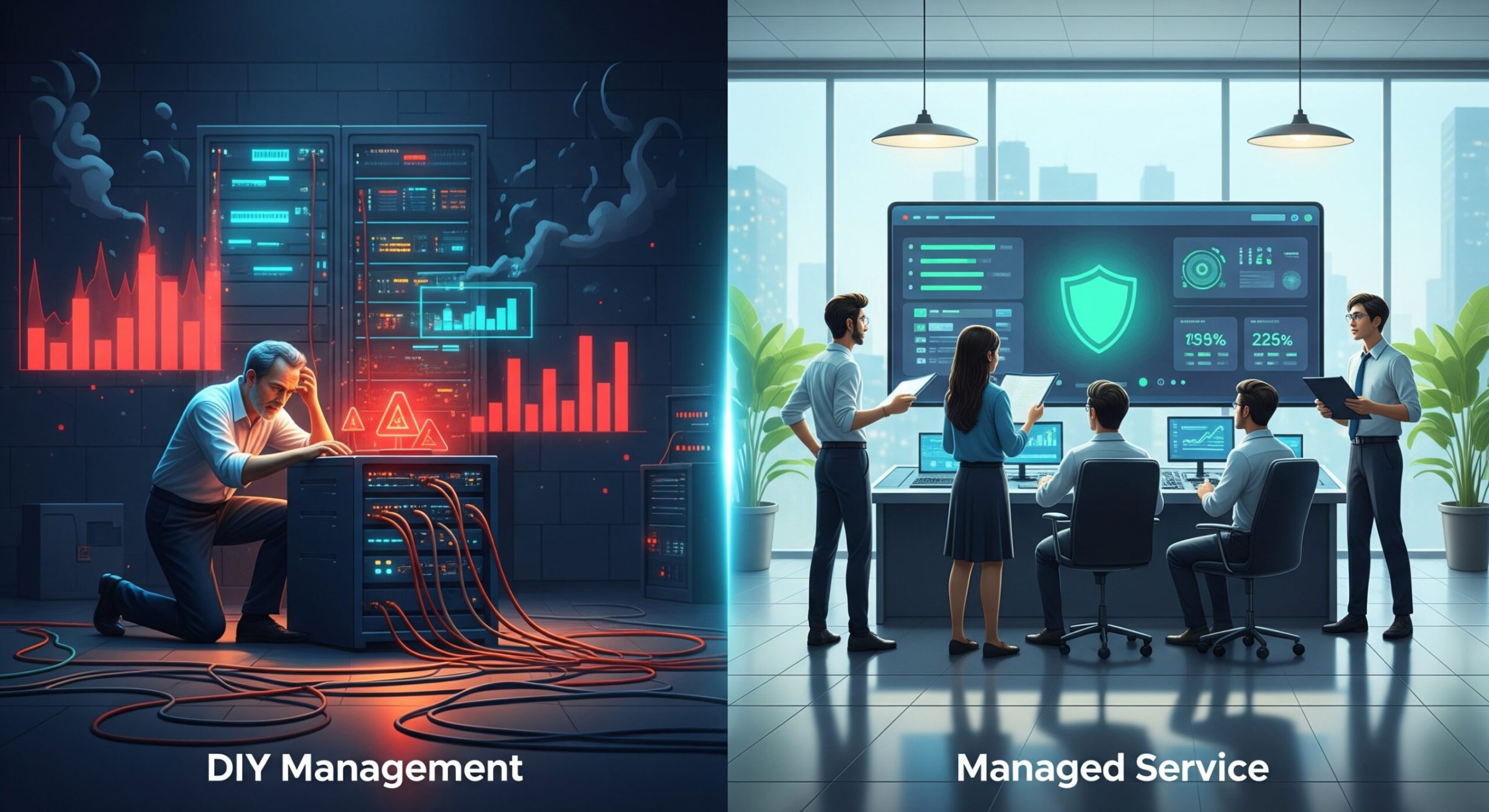
The True Cost of FortiGate Management: DIY vs. a Managed Service

In today’s complex digital landscape, a robust firewall is not a luxuryit’s the cornerstone of your business’s defense. FortiGate firewalls are a top-tier choice for organizations of all sizes, offering powerful security and performance. But purchasing the hardware is only the first step. The critical question that every IT leader must answer is: Is it more cost-effective to manage this vital asset in-house or to partner with a managed service provider?

The answer isn’t as simple as comparing the cost of the appliance to a monthly service fee. This article will break down the real fortigate management cost, exploring the hidden and apparent expenses of both a Do-It-Yourself (DIY) approach and a fully managed service.

The Hidden and Apparent Costs of In-House FortiGate Management

Calculating the true cost of a self-managed firewall means looking beyond the initial invoice. The total cost of ownership for a DIY approach includes significant operational expenses that can quickly eclipse the initial hardware investment.

Hardware and Licensing

This is the most straightforward cost: the price of the FortiGate appliance itself, along with the necessary annual licensing for FortiGuard services like threat protection, web filtering, and antivirus. While this is a significant line item, it’s often the smallest part of the long-term financial picture.

Personnel Costs

This is the most significant “hidden” cost in any in-house vs outsourced IT security analysis. A FortiGate firewall isn’t a “set it and forget it” device. It requires constant attention from a skilled professional. This includes:

  • Dedicated Staff: A qualified network security engineer with Fortinet experience commands a high salary and benefits. If you don’t have one, you’ll face a competitive hiring market.
  • Divided Attention: More commonly, existing IT staff are tasked with firewall management. Every hour they spend on firewall configuration, patching, and log analysis is an hour they aren’t spending on strategic projects that drive business growth.

Training and Certification

The cybersecurity landscape is constantly evolving, and so is Fortinet’s technology. To manage a firewall effectively, your staff needs ongoing training and certifications. These costs include course fees, exam fees, and the time employees are away from their primary duties. Without this investment, your firewall can quickly become outdated and vulnerable.

24/7/365 Monitoring and Response

Cyber threats don’t operate on a 9-to-5 schedule. True security requires around-the-clock monitoring and the ability to respond to an alert at a moment’s notice. For most small and medium-sized businesses, staffing an internal, 24/7 security operations center (SOC) is financially and logistically impossible.

Tools and Software

Effective firewall management requires a supporting ecosystem of tools for log management, performance monitoring, and security information and event management (SIEM). These platforms come with their own licensing fees and maintenance requirements, adding another layer to your total cost.

Understanding Managed Firewall Pricing Models

In contrast to the variable and often unpredictable costs of DIY, managed firewall pricing is designed for clarity and predictability. When you engage a Managed Service Provider (MSP), you aren’t just outsourcing tasks; you’re gaining a partner that provides a comprehensive security service for a fixed monthly fee.

This service typically includes:

  • 24/7/365 monitoring and incident response by a team of certified experts.
  • Proactive device management, including patching and updates.
  • Regular security policy reviews and optimization.
  • Access to advanced security and reporting tools.
  • A Service Level Agreement (SLA) that guarantees uptime and response times.

This transforms your security budget from a volatile mix of capital and operational expenses into a predictable operating expense (OpEx) that is easy to budget for.

The Definitive Comparison: In-House vs. Outsourced IT Security

The choice becomes clearer when you compare the two models side-by-side.

FeatureIn-House (DIY) ManagementManaged Firewall Service
Total Cost of OwnershipHigh and unpredictable (salary, training, tools)Predictable and often lower over time
Expertise & CertificationLimited to your internal team; expensive to maintainAccess to a team of certified security professionals
24/7 MonitoringExtremely difficult and expensive to staffIncluded; SOC services are standard
Threat Response TimeDependent on staff availability and alertnessInstantaneous, guided by strict SLAs
ScalabilitySlow and requires new hires or significant trainingRapid; scales with your business needs
Predictable Monthly CostsNo, costs fluctuate with staffing and incidentsYes, a fixed monthly fee for easier budgeting
Resource AllocationPulls your IT team away from strategic projectsFrees your IT team to focus on core business goals

Key Factors to Consider When Making Your Decision

To find the right path for your organization, ask yourself these critical questions:

  1. Do we have the certified, in-house expertise to configure our firewall and effectively respond to advanced cyber threats?
  2. What is the real financial and reputational impact of a security breach caused by a misconfigured firewall?
  3. Could our IT team generate more business value if they were freed from daily firewall administration?
  4. How quickly can we scale our security operations to match our business growth?

Conclusion

While the idea of managing your own FortiGate firewall can seem like a way to save money, the reality is that the true fortigate management cost is often far higher than anticipated. When you factor in the costs of specialized staff, continuous training, and the immense challenge of 24/7 monitoring, the value of a managed service becomes undeniable.

A managed firewall service offers a more secure, scalable, and ultimately more cost-effective solution. It provides access to a level of expertise and vigilance that most businesses cannot afford to build in-house, transforming your security posture from a liability into a strategic asset.

Call to Action

Stop worrying about the complexities of firewall management. Contact us today for a free consultation and a transparent quote on our managed FortiGate services. Let us handle your security so you can focus on your business.

Securing Your Network: Top 5 FortiGate Configurations Best Handled by a Managed Service

Your FortiGate firewall is a powerful shield for your network, a cornerstone of your cybersecurity defense. But are you certain it’s configured for maximum protection? In the face of increasingly sophisticated cyber threats, a default or “set-it-and-forget-it” approach to firewall management is a significant risk. The complexity of an optimal setup requires deep expertise and continuous attention.

This is where a FortiGate managed service becomes a game-changer. It provides the expert oversight needed to transform your firewall from a simple barrier into an intelligent, proactive defense system. For businesses without a large, dedicated security team, its the most effective way to ensure robust protection.

This article explores the top five critical FortiGate configurations that are best entrusted to a certified managed service provider (MSP), ensuring your network is not just protected, but truly secure.

First, What is a FortiGate Managed Service? (And Why It Matters)

A FortiGate managed service is an offering where a third-party team of certified cybersecurity experts takes responsibility for the 24/7 monitoring, management, and maintenance of your FortiGate firewalls. Think of it as having a team of elite Fortinet specialists guarding your digital front door around the clock.

The core benefits extend beyond simple device management:

  • Proactive Threat Hunting: Continuous monitoring for suspicious activity.
  • Expert Configuration: Implementation of security best practices.
  • Regular Maintenance: Crucial firmware updates and performance tuning.
  • Peace of Mind: Knowing your network is protected by industry professionals.

By leveraging an MSP, you gain access to a level of expertise that is difficult and expensive to maintain in-house, allowing you to focus on your core business operations.


The Top 5 Critical FortiGate Configurations for Your Business Security

A managed service doesn’t just watch over your firewall; they unlock its most powerful features. Here are five key configurations they expertly handle to fortify your defenses.

1. Advanced Firewall Policies and Rule Optimization

A firewall’s strength lies in its rules. A poorly configured rule set can leave gaping holes in your defense. A managed service moves beyond basic “allow” and “deny” rules to implement a strategy of least privilege access.

  • What it is: This involves a meticulous review of all firewall policies to ensure that users, devices, and applications only have the absolute minimum level of access required to perform their functions. It includes optimizing rule order for performance and properly configuring Network Address Translation (NAT).
  • Why it’s critical: A cluttered or overly permissive rule set is a common vector for attack. An attacker who compromises a low-level user account could gain broad access to sensitive parts of the network if policies are not restrictive.
  • The MSP Value: Certified engineers continuously audit and refine firewall rules. They remove outdated or redundant policies, ensure new rules are implemented securely, and document everything, which is crucial for performance, security, and compliance audits.

2. Unified Threat Management (UTM) Security Profile Hardening

Modern FortiGate firewalls are equipped with a powerful suite of security features known as Unified Threat Management (UTM). Simply turning them on is not enough; they must be precisely tuned.

  • What it is: This is the fine-tuning of the integrated security profiles that make up Fortinets Security Fabric. This includes:
    • Antivirus: Configuring real-time scanning of traffic entering the network.
    • Web Filtering: Blocking access to malicious websites, phishing links, and enforcing company acceptable-use policies.
    • Intrusion Prevention System (IPS): Proactively identifying and blocking known cyberattack patterns and exploits before they can do damage.
    • Application Control: Granularly managing which applications (like Dropbox, Teams, or social media) are allowed to run on the network and by whom.
  • Why it’s critical: UTM features are your primary defense against malware, ransomware, and other advanced threats. If they are not properly configured, malicious files can slip through, and productivity can be impacted.
  • The MSP Value: A managed service has the expertise to configure these profiles without disrupting legitimate business traffic. They ensure signatures and threat intelligence are constantly updated, applying new protections as soon as they become available to defend against zero-day threats.

3. Secure VPN Access (SSL-VPN and IPsec)

In an era of hybrid work, providing secure remote access is non-negotiable. A misconfigured VPN is like leaving a back door unlocked.

  • What it is: This involves the proper setup and hardening of both SSL-VPNs, which allow individual remote employees to connect securely, and IPsec VPNs, which create secure tunnels between office locations.
  • Why it’s critical: VPNs extend your secure network perimeter to wherever your employees are. A weak configuration can expose your entire internal network to threats if a remote user’s device is compromised.
  • The MSP Value: An MSP will implement robust security on your VPNs, enforcing strong encryption standards, implementing multi-factor authentication (MFA) for access, and configuring split-tunneling policies correctly to ensure that all business traffic is inspected, no matter where the user is.

4. Robust User Authentication and Identity Management

Knowing who is on your network is as important as keeping threats out. Strong authentication ensures that only authorized individuals can access your data and systems.

  • What it is: This configuration focuses on integrating the FortiGate firewall with your company’s directory services, such as Microsoft Active Directory or Azure AD. It involves setting up Single Sign-On (SSO) and, most importantly, enforcing Multi-Factor Authentication (MFA).
  • Why it’s critical: Stolen credentials are one of the most common ways attackers breach a network. MFA is the single most effective defense against this, adding a crucial layer of security that prevents unauthorized access even if a password is compromised.
  • The MSP Value: A managed service handles the complex integration between your FortiGate and identity providers. They can roll out and manage MFA across your user base for firewall and VPN access, ensuring a seamless yet highly secure user experience and providing detailed logs of who is accessing what and when.

5. Proactive Monitoring, Logging, and Firmware Management

The cybersecurity landscape is never static. A firewall requires constant vigilance and maintenance to remain effective.

  • What it is: This is the ongoing, day-to-day work of security. It involves centralizing firewall logs for analysis (often with a tool like FortiAnalyzer), setting up alerts for suspicious events, and methodically testing and applying critical firmware updates released by Fortinet.
  • Why it’s critical: Without comprehensive logging, you have no way of knowing if your firewall is under attack or has been breached. Firmware updates often contain patches for critical vulnerabilities that attackers are actively exploiting. Falling behind on updates is one of the biggest and most common security risks.
  • The MSP Value: This is where an MSP truly shines. Their 24/7 Security Operations Center (SOC) provides the constant monitoring and expert analysis that is impossible for most businesses to replicate. They manage the entire lifecycle of firmware updatesfrom vetting and testing to scheduled deploymentensuring your defenses are always up-to-date without causing business disruption.

Partner with Experts to Maximize Your Security

Your FortiGate firewall is a critical investment in your company’s security. By entrusting its configuration and management to a specialized managed service provider, you ensure that investment yields the highest possible return. You gain not only a hardened security posture but also the freedom to focus on what you do bestrunning your business.

Is your FortiGate firewall configured for complete protection?

Contact us today for a complimentary security assessment. Our certified Fortinet experts will help you understand your current security posture and identify opportunities to strengthen your defenses.

Key Features & Benefits of FortiGate Firewalls

In today’s digital-first world, your network is the backbone of your business. But with this connectivity comes exposure to an ever-expanding landscape of cyber threats. From sophisticated ransomware to stealthy malware, the risks are real and relentless. This is where a robust, intelligent firewall becomes not just an IT asset, but a fundamental pillar of your business’s defense.

Enter FortiGate, the industry-leading Next-Generation Firewall (NGFW) from Fortinet. FortiGate firewalls provide the security, performance, and visibility you need to protect your network without compromise. But how do they do it? And more importantly, how can you ensure you’re leveraging their full, powerful potential?

This guide will break down the key FortiGate features, explore the core Fortinet benefits, and reveal how partnering with a managed service provider like BALANCED+ for managed FortiGate advantages can elevate your security posture from strong to virtually unbreachable.

The Power Within: A Look at Key FortiGate NGFW Capabilities

FortiGate firewalls are more than just gatekeepers for your network traffic. They are sophisticated security platforms packed with advanced features designed to work together, providing a deep, multi-layered defense.

  • Fortinet Security Fabric: This is the cornerstone of FortiGate’s power. The Security Fabric is an intelligent, integrated architecture that allows different Fortinet security solutions (like firewalls, endpoint security, and cloud security) to communicate and collaborate. This creates a unified and automated security posture that can see and respond to threats across your entire network in real-time.
  • AI-Powered Advanced Threat Protection (ATP): FortiGate doesn’t just block known threats; it proactively hunts for new ones. Using artificial intelligence and machine learning, its ATP servicesincluding antivirus, intrusion prevention (IPS), and sandboxingcan identify and neutralize sophisticated, zero-day attacks before they can execute.
  • High-Performance SSL/TLS Inspection: With over 90% of internet traffic now encrypted, cybercriminals increasingly hide malware within SSL/TLS traffic. Many firewalls struggle to inspect this encrypted data without causing significant network slowdowns. FortiGate’s custom-built Security Processors (SPUs) provide industry-leading performance for deep SSL inspection, eliminating this dangerous blind spot.
  • Secure SD-WAN: For businesses with multiple locations, FortiGate offers built-in Secure SD-WAN functionality. This allows you to optimize and secure your wide area network, improving application performance and reducing connectivity costs without sacrificing security. Its a game-changer for distributed enterprises.
  • Granular Application & Web Filtering: Take control of your network environment. FortiGate provides deep visibility and granular control over thousands of applications and web categories. You can enforce acceptable use policies, block risky or unproductive applications, and prevent shadow IT, all from a single, intuitive console.

Translating Features into Business Value: The Core Fortinet Benefits

The impressive list of FortiGate features directly translates into tangible benefits for your organization.

  • Consolidated Security, Simplified Management: By integrating multiple security functions (firewall, IPS, antivirus, SD-WAN) into a single platform, FortiGate reduces complexity and lowers your total cost of ownership. You manage less hardware and fewer vendors, streamlining your security operations.
  • Unmatched Performance: Thanks to its patented SPU technology, FortiGate delivers high-throughput threat protection that won’t become a bottleneck for your business operations. You get top-tier security without sacrificing network speed.
  • Superior Threat Protection: The combination of AI-powered threat intelligence from FortiGuard Labs and the integrated Security Fabric ensures you are protected against the full spectrum of modern cyber threats.
  • Complete Visibility: You can’t protect what you can’t see. FortiGate provides a comprehensive, real-time view of your network traffic, users, devices, and applications, empowering you to make faster, more informed security decisions.

Maximize Your Investment: The Managed FortiGate Advantages with BALANCED+

Owning a FortiGate firewall is a powerful first step. But to truly unlock its full potential and ensure it’s always operating at peak performance, you need expertise and constant vigilance. This is where a managed service partnership shines.

Heres how BALANCED+ maximizes your FortiGate investment:

  • 24/7/365 Expert Management & Monitoring: Our certified security professionals become an extension of your team, monitoring your firewall around the clock. We handle all the day-to-day management, from patching and updates to performance tuning, so you can focus on your core business.
  • Proactive Threat Hunting: We don’t wait for alerts. Our team proactively hunts for indicators of compromise and anomalous activity within your network. By leveraging the deep visibility of your FortiGate, we can identify and neutralize threats before they become incidents.
  • Optimized Configuration & Policy Management: A firewall is only as good as its configuration. We ensure your FortiGate is perfectly tailored to your specific business needs and risk profile. We continuously refine policies to adapt to new applications, evolving threats, and changing business requirements, ensuring optimal protection without hindering productivity.
  • Reduced Overhead and Access to Expertise: Building and retaining an in-house team of certified security experts is expensive and challenging. Partnering with BALANCED+ gives you immediate access to a deep bench of Fortinet specialists for a fraction of the cost.
  • Actionable Reporting & Compliance: We provide clear, concise reports that translate complex security data into actionable business intelligence. We also help you navigate the complexities of compliance requirements (like PIPEDA, PCI DSS, etc.), using your FortiGate’s logging and reporting capabilities to streamline audits.

Secure Your Future with FortiGate and BALANCED+

FortiGate firewalls deliver an unparalleled combination of performance, features, and integrated security. They provide the foundation for a secure, resilient network capable of supporting your business goals.

By pairing these powerful FortiGate NGFW capabilities with the expert oversight and proactive management from BALANCED+, you’re not just buying a firewallyou’re investing in a comprehensive security strategy. You gain peace of mind, knowing your most critical asset is protected by the best technology and the sharpest minds in the industry.

Ready to unlock the full potential of your network security? Contact the experts at BALANCED+ today for a complimentary consultation and discover the managed FortiGate advantages.

Compliance and Reporting with Managed FortiGate Services

For organizations in finance, healthcare, and retail, the rules set by standards like PCI DSS, HIPAA, and SOX are non-negotiable, with steep fines and significant reputational damage awaiting those who fall short. FortiGate firewalls are powerful tools in the security arsenal, but their true strength lies in proper configuration and meticulous reporting. The real challenge lies not in their capability, but in harnessing them to consistently meet stringent compliance demands.

This is where many businesses find themselves on a tightrope, balancing security operations with the burdensome task of audit preparation.

This guide will explore the common hurdles of FortiGate compliance and reporting and reveal how managed services can transform this complex burden into a streamlined, automated process, ensuring you are always ready for your next audit.

The Compliance Conundrum: Common Hurdles in FortiGate Reporting

Choose the Right FortiGate From The Start

Take our quick quiz to get a personalized suggestion for your business.

Start Quiz
Modern abstract graphic representing potential or growth

Managing a FortiGate firewall for compliance is more than just setting it up. It involves constant vigilance and navigating several key challenges:

  • The Data Deluge: A FortiGate device generates a massive volume of logs. Sifting through this data to find security incidents or extract the specific information required for a compliance report is like finding a needle in a digital haystack. Without the right tools, it’s an overwhelming and error-prone task.
  • The Expertise Gap: Configuring a firewall to meet the specific controls of a regulation like PCI DSS requires a specialized skillset. This expertise is in high demand and can be difficult and expensive to maintain in-house. A minor misconfiguration can easily lead to a failed audit.
  • The Time Sink: The manual process of collecting logs, correlating events, and formatting reports for a managed firewall audit can consume countless man-hours. This is valuable time your IT team could be spending on strategic initiatives that drive business growth.
  • Keeping Pace with Change: Compliance regulations and the threat landscape are constantly evolving. Keeping firewall configurations, rulebases, and firmware updated to address new threats and shifting regulatory goalposts is a relentless, ongoing effort.

Demystifying the Managed Firewall Audit: What to Expect

A managed firewall audit is a formal review conducted to verify that your firewall’s configuration and operations align with specific regulatory requirements and internal security policies. Understanding its stages is key to preparation:

  1. Scope Definition: The audit begins by identifying which regulations (e.g., PCI DSS, HIPAA) and internal policies are in scope for the review.
  2. Information Gathering: Auditors will request extensive documentation. This is the heart of FortiGate compliance reporting and includes firewall rule reviews, change management logs, user access reports, and proof of regular configuration backups.
  3. Configuration and Firmware Validation: This stage involves a deep dive into the firewall’s technical setup to ensure it is securely configured and running a recent, patched version of its firmware.
  4. Rulebase Analysis: Auditors will scrutinize every firewall rule to ensure it is necessary, restrictive enough (least privilege), and properly documented. Orphaned or overly permissive rules are major red flags.

A managed service provider proactively prepares for every one of these stages, ensuring that when the auditors arrive, the documentation is organized, the configurations are compliant, and the process is seamless.

A Laser Focus on PCI Compliance with Fortinet

For any organization that handles cardholder data, Fortinet PCI compliance is a top priority. The Payment Card Industry Data Security Standard (PCI DSS) outlines 12 core requirements for protecting this sensitive information. A managed FortiGate service is instrumental in meeting several of these key requirements:

  • Requirement 1: Build and Maintain a Secure Network: An MSP ensures your FortiGate firewall is expertly configured and maintained with a validated rulebase to protect the cardholder data environment.
  • Requirement 10: Track and Monitor All Access to Network Resources and Cardholder Data: Managed services provide the 24/7 log monitoring, correlation, and real-time alerting necessary to detect and respond to suspicious activity, generating the audit trails required by PCI DSS.
  • Requirement 11: Regularly Test Security Systems and Processes: Managed service providers can assist with or support the regular vulnerability scans and penetration tests required to prove the security of the firewall and the network it protects.
  • Requirement 12: Maintain a Policy that Addresses Information Security: An MSP provides the detailed documentation, change logs, and regular reports that form the backbone of a robust information security policy.

The Managed Services Advantage: Your Path to Effortless Compliance

Partnering with a managed service provider (MSP) for your FortiGate firewalls shifts the compliance burden from your team to a team of dedicated experts. This delivers tangible advantages:

  • 24/7 Monitoring and Expert Alerting: Go beyond simple log collection. An MSP provides round-the-clock monitoring by certified security analysts who can distinguish between routine events and genuine threats, ensuring rapid response.
  • Expert Configuration and Management: Your firewall is managed by certified Fortinet engineers who live and breathe security and compliance. They ensure your device is always optimally configured to meet both security and regulatory needs.
  • Automated and Customized Reporting: Receive clear, concise, and audit-ready reports tailored to your specific compliance needs. Whether it’s for PCI DSS, HIPAA, or an internal review, you get the documentation you need, when you need it, without the manual effort.
  • Simplified Audit Preparedness: Walk into your next audit with confidence. The MSP does the heavy lifting of gathering evidence, documenting processes, and ensuring all technical controls are met and recorded.
  • Cost-Effectiveness: When you factor in the cost of hiring, training, and retaining specialized in-house security talent, the price of potential compliance fines, and the man-hours lost to manual reporting, a managed service offers a significantly higher return on investment.

Conclusion: From Compliance Burden to Business Enabler

In today’s complex digital world, compliance cannot be an afterthought. By leveraging a managed service for your FortiGate firewalls, you can transform compliance from a stressful, reactive burden into a predictable and continuous business process. This strategic shift not only hardens your security posture but also frees your team to focus on what they do best: driving your business forward. You gain peace of mind, fortified security, and a true strategic partner in your success.

Ready to simplify your FortiGate compliance and ace your next audit? Contact us today for a free consultation and learn how our managed services can provide the reporting, expertise, and peace of mind you need.