
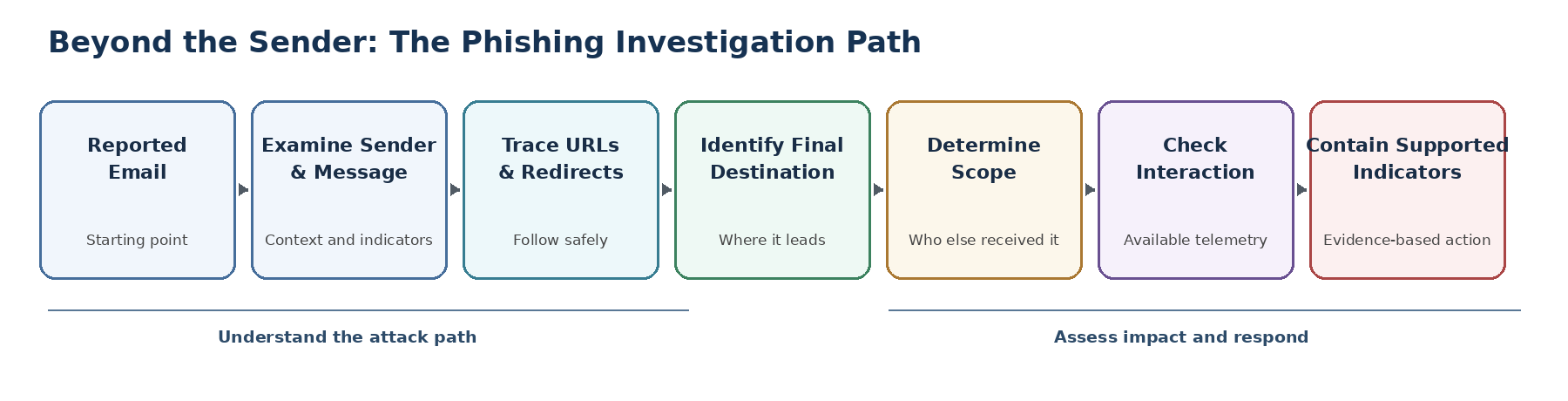
A reported phishing email may look like a single-message problem. A proper investigation looks beyond the sender to determine where the message leads, how far it reached, whether anyone interacted with it, and what actually needs to be contained.
Security awareness training has made many employees more familiar with the warning signs of phishing. A suspicious sender, an unexpected request, or an unusual link may be enough for someone to stop and report the message to IT. That report is important, but for the security team it is only the beginning of the investigation.
A phishing email rarely exists as just a sender and a message. Behind it may be a chain of redirects, separate destination domains, additional recipients, and evidence of user interaction. Looking only at the sender address can answer one question while leaving several more important ones unresolved: Where does the message actually lead? Who else received it? Did anyone interact with it? And what should actually be contained?
By the numbers
28%
of breaches investigated by Microsoft Incident Response were initiated through phishing or social engineering. (Microsoft Digital Defense Report 2025)
$2.77B
in reported 2024 losses associated with Business Email Compromise complaints. (FBI Internet Crime Complaint Center)
The Sender Is Only the Starting Point
The sender address still matters. It can help establish whether a message came from an expected source, whether the sending domain is suspicious, and whether the same sender appears elsewhere in the environment. But it is only one indicator. Attackers can spoof identities, abuse legitimate services, rotate sending accounts, or use one domain to deliver a message that ultimately sends the recipient somewhere completely different.
This is why a reported message should be treated as an entry point into the investigation rather than the entire incident. The objective is not simply to decide whether the From address looks suspicious. It is to reconstruct enough of the activity to understand the threat and respond proportionately.
Follow Where the Message Actually Leads
In several phishing investigations, one of the most useful questions has been simple: where would the user actually end up? The URL displayed in a message may not be the final destination. A link can pass through a legitimate service, tracking mechanism, or redirect before reaching infrastructure controlled or abused by the attacker.
That makes URL analysis more than a reputation check on the first domain we see. The redirect chain and final destination can reveal infrastructure that is more relevant to containment than the visible sender itself. This analysis should be performed safely using appropriate security tooling or an isolated analysis environment, not by casually opening suspicious links from a production workstation.
The destination also needs context. Domain reputation, registration information, security detections, message characteristics, and other threat intelligence can all contribute evidence. No single result should become the verdict. A newly registered domain is not automatically malicious, and a clean reputation result does not prove a site is safe. The stronger conclusion comes from correlating multiple indicators with what the message is actually trying to make the recipient do.
Good to know: The domain visible in an email is not necessarily the final destination. Redirects can move a user through multiple services or domains before reaching the actual landing page. Investigating that chain can reveal indicators that are not obvious from the original message.
One Report May Reveal a Wider Campaign
The employee who reports a phishing email sees one message. The investigator needs to determine whether that message is isolated or part of something larger.
Message tracing and email security telemetry can show whether similar messages reached other recipients, when they were delivered, and whether related activity exists. This changes the question from “Is this email suspicious?” to “What is the scope of this activity?” Microsoft Defender for Office 365, for example, correlates campaign information such as sending sources, recipients, payload URLs, delivery state, and URL clicks. Trend Micro email security tooling similarly exposes suspicious URLs, related messages, and recent recipients.
That scope matters operationally. Blocking one sender may address the message that was reported, but it may not address copies already delivered to other users or a malicious destination being reused through different messages.
Establishing Delivery Does Not Establish Impact
Finding additional recipients establishes the reach of a message, but it does not by itself establish compromise. Delivery, link interaction, credential submission, and malicious execution represent different levels of potential impact, and each requires its own supporting evidence.
Where the security platform provides the visibility, investigators can review click or interaction telemetry and correlate it with the affected messages. The wording of the conclusion matters as well. If no interaction appears in the available telemetry, the defensible finding is that no interaction was observed in that telemetry, not an absolute claim that no user could have interacted with the message.
If the evidence indicates credential submission, malware execution, or another form of compromise, the investigation should expand beyond email. That may require reviewing authentication activity, sessions, endpoint telemetry, mailbox changes, or other evidence appropriate to the incident.
Important: A delivered message, a clicked link, and a compromised account are different findings. Each requires different evidence and can lead to a different response.
Contain What the Evidence Supports
Containment should follow the evidence, and it does not always mean blocking everything associated with a message. Depending on the investigation, the appropriate action might include blocking a confirmed malicious sender, URL, domain, or related infrastructure; removing delivered messages; or adding confirmed indicators to the organization’s security controls.
Containment can also begin before every investigative question has been answered when the evidence is strong enough to justify reducing exposure. The investigation then continues to determine whether the scope or response needs to expand. At the same time, overly broad blocking can disrupt legitimate business communication, so the response should remain proportional to what the evidence supports.
Good to know: More blocking is not always better. Blocking an entire legitimate domain because one sender or URL is suspicious can disrupt business communications. Effective containment targets the indicators the investigation actually supports.
A phishing report may begin with one suspicious email, but a sound investigation looks beyond the sender. Following the attack path helps determine where the message leads, how broadly it was delivered, whether users interacted with it, and which indicators actually need to be contained.
What Organizations Can Take From This
Organizations should make it easy for employees to report suspicious messages, but the process should not end with the report. Effective response also depends on having enough visibility to determine who received the message, investigate the infrastructure behind it, review available interaction telemetry, and act on confirmed malicious indicators. That requires the right email security controls, logging, response procedures, and technical expertise to turn a user report into an informed security decision.
Questions your organization should be able to answer
- When an employee reports phishing, who investigates it?
- Can you determine whether other employees received the same message?
- Can you safely analyze where suspicious links ultimately lead?
- Can you determine whether available telemetry shows user interaction?
- Can you remove malicious messages already delivered to other mailboxes?
- Can you block confirmed indicators without unnecessarily disrupting legitimate communication?
- If compromise is suspected, is there a defined path to broader incident response?
The Bottom Line
For organizations, the difference between receiving a phishing report and responding effectively is the capability behind that report. Someone still needs to investigate the message, determine its scope, assess potential interaction, contain confirmed threats, and recognize when the evidence requires a broader incident response.
A user reporting a suspicious email may be the first line of defense. What happens next determines how effective that defense actually is. The investigative work behind the report is what turns one suspicious message into an evidence-based security response that can protect the wider organization.
Sources
- NIST SP 800-61 Rev. 3: Incident Response Recommendations and Considerations for Cybersecurity Risk Management, NIST, 2025
- Microsoft Digital Defense Report 2025, Microsoft, 2025
- Microsoft Defender for Office 365: Track and respond to emerging security threats with campaigns, Microsoft Learn
- Trend Micro: Email Security Operations and suspicious-object investigation documentation, Trend Micro
- FBI Internet Crime Complaint Center: 2024 IC3 Annual Report, FBI, 2025

 Paul Thresher