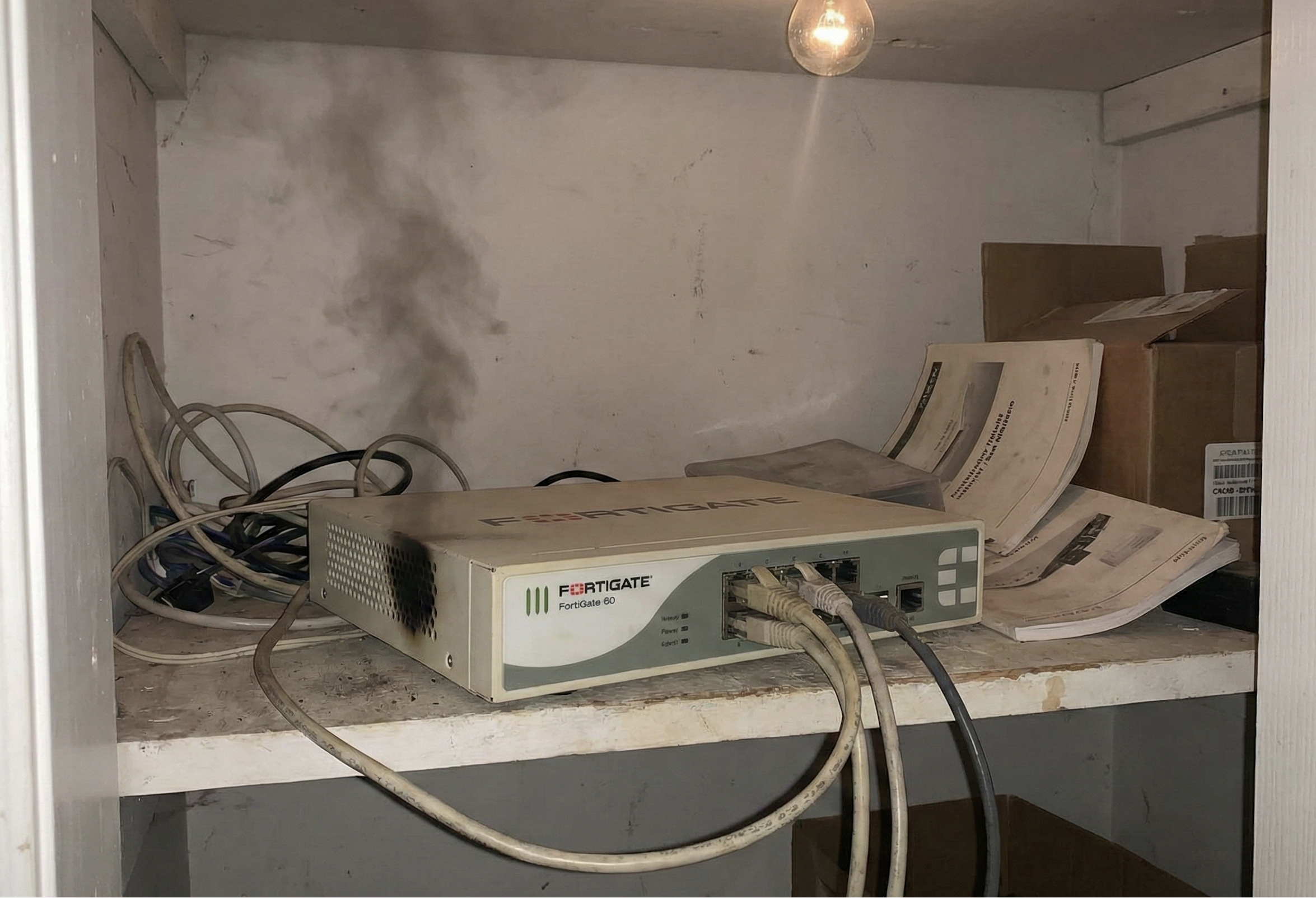

The firewall humming away in your server closet might be the most expensive piece of equipment in your office. Not because of what you paid for it years ago, but because of what it’s costing you right now while appearing to cost nothing at all.
It still powers on. Lights still blink. Traffic still flows. Your IT person says it’s fine. So you leave it alone, because you have actual fires to fight and a business to run.
But “still working” and “still protecting you” are two very different things. And the gap between them is where the real costs hide.
The Comfort of “It Still Works”
There’s a certain logic to keeping equipment running as long as possible. You paid for it. It functions. Replacing something that isn’t broken feels wasteful, especially when budgets are tight and a dozen other priorities compete for every dollar.
So the FortiGate you bought five or six years ago stays in place. Maybe your IT person has mentioned upgrading, but it wasn’t urgent. Maybe you looked at replacement costs and decided next year made more sense. Maybe nobody’s mentioned it at all, and you assumed no news meant good news.
This is how most businesses end up running outdated firewalls. Not through neglect, but through reasonable decisions that made sense at the time. The problem is that firewall security doesn’t age gracefully. What protected you in 2019 isn’t equipped for what’s attacking you in 2025.
What “End of Support” Actually Means
Every FortiGate model follows a lifecycle. Fortinet announces end-of-sale dates, then end-of-support dates, then end-of-vulnerability-support dates. These aren’t arbitrary deadlines designed to sell more hardware. They mark real transitions in what that device can do for you.
When a FortiGate reaches end of support, Fortinet stops releasing firmware updates for it. When it reaches end of vulnerability support, they stop patching security flaws entirely. Your firewall still powers on. It still passes traffic. But it’s frozen in time, running software that will never improve while threats continue evolving.
That model that felt cutting-edge when you bought it is now running firmware designed for a threat landscape that no longer exists. New attack techniques, new malware variants, new exploitation methods. None of them accounted for in the code protecting your network.
The firewall doesn’t know it’s obsolete. It just keeps doing what it was programmed to do. The gap between that and what you actually need grows wider every month.
The Security Gaps You Can’t See
Modern firewalls don’t just block traffic based on ports and protocols. They inspect encrypted connections, analyze application behavior, check files against threat intelligence feeds, and identify patterns that suggest compromise. At least, current ones do.
Older FortiGate models lack the processing power to inspect modern encrypted traffic volumes without crippling your network speed. Their threat intelligence subscriptions have expired or no longer update. Their inspection engines don’t recognize attack patterns that emerged after their last firmware update.
You’re essentially running antivirus from 2020 against malware from 2025. The firewall is still checking, still filtering, still doing its job as it understands it. But its understanding is years out of date.
The threats targeting SMBs today look nothing like they did when your firewall was current:
- Ransomware that evades signature-based detection entirely
- Encrypted command-and-control traffic that older inspection can’t analyze
- Living-off-the-land attacks that don’t trigger traditional firewall rules
- Credential theft techniques that bypass perimeter controls completely
Your outdated FortiGate isn’t failing. It’s succeeding at an outdated job.
The Performance Tax You’re Paying Daily
Security gaps aside, older hardware simply can’t keep up with modern network demands. When your FortiGate was sized, your team probably worked mostly on-site. Video calls were occasional. Cloud applications were supplementary. Encrypted traffic was a fraction of total volume.
Now encrypted traffic is nearly everything. Video conferencing runs constantly. Cloud applications are primary business tools. Remote workers VPN in from home offices. And that firewall sized for 2019 workloads is choking on 2025 reality.
The symptoms show up in ways that rarely get traced back to the firewall:
- VPN connections that lag or drop during peak hours
- Video calls that freeze or pixelate
- Cloud applications that feel sluggish
- File transfers that crawl
- Remote workers complaining about “the internet” being slow
Your IT person troubleshoots the ISP, the switches, the WiFi, the endpoints. Sometimes they find something. Sometimes they just shrug. But the bottleneck sitting at your network’s front door rarely gets questioned because it’s “still working.”
Meanwhile, productivity drains away in ten-second delays and frozen screens, none of which show up on any invoice.
The Compliance Exposure Nobody Mentioned
If your business handles customer data, processes payments, or serves clients with security requirements, your firewall age isn’t just a technical concern. It’s a compliance exposure.
Auditors asking about your security controls will want to know if your firewall receives current patches. Running end-of-support hardware is a finding. It goes in the report. It raises questions about what other corners you’ve cut.
Cyber insurance carriers are getting more sophisticated about what they’ll cover. Application questionnaires now ask about infrastructure age, patch status, and end-of-life equipment. A claim denial because you were running unsupported hardware is not a theoretical risk. It’s happening to businesses right now.
Customer security questionnaires increasingly ask about firewall patch currency. Enterprise clients doing vendor risk assessments want to know your perimeter is current. Losing a deal because you couldn’t answer those questions honestly hurts more than a hardware refresh ever would.
The compliance cost of outdated equipment rarely announces itself until you’re sitting across from an auditor, an insurance adjuster, or a customer’s security team.
The Hidden Costs That Don’t Show Up on Invoices
Every workaround has a cost. Every limitation creates friction. Every band-aid consumes time that could go elsewhere.
Your IT person spending hours troubleshooting performance issues that trace back to underpowered hardware. That’s a cost. Projects delayed because the firewall can’t support new requirements. That’s a cost. The emergency premium you’ll pay when the device finally fails and you need replacement hardware overnight. That’s a cost.
Planned replacements happen on your timeline, with competitive pricing, proper configuration, and minimal disruption. Emergency replacements happen on the equipment’s timeline, with expedite fees, rushed implementation, and whatever’s available in stock.
The businesses that budget for infrastructure refreshes spend less over time than the businesses that run equipment until it fails. The math isn’t intuitive, but it’s consistent.
When “Saving Money” Becomes the Most Expensive Decision
The calculus feels simple on the surface. Replacement costs money. Keeping current equipment costs nothing. Except that’s not actually true.
Keeping outdated equipment costs you in security exposure, in performance degradation, in compliance risk, in insurance complications, in deals you can’t close, in productivity you can’t measure, and eventually in emergency replacement premiums.
The firewall that costs nothing on your monthly budget might be the most expensive line item you’re not tracking.
This isn’t about fear. It’s about seeing the full picture. The equipment you trust most deserves the most scrutiny, because you’ve built your entire network security assumption on its capabilities.
Understanding Your Options
If your FortiGate is approaching end of life, or passed it without anyone noticing, the path forward isn’t necessarily complicated. It starts with understanding where your current hardware sits in its lifecycle and what a refresh would actually involve.
BALANCED+ is a Fortinet Gold Partner, which means we work directly with Fortinet and can help you get the best pricing available on new FortiGate hardware. Whether you need a straightforward replacement or want to right-size your firewall for where your business is headed, we can help you understand the options without the pressure.
Your firewall should be an asset, not a liability hiding in plain sight.