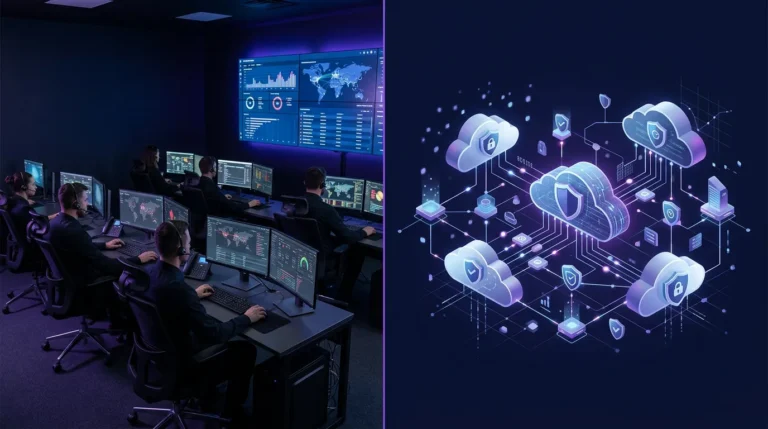

Your security team is drowning in alerts. Every week brings another vendor pitch promising to “stop threats in real time.” But when you dig into the options, two solutions keep coming up: MDR (Managed Detection and Response) and SIEM (Security Information and Event Management). They sound similar. They’re not.
This post breaks down what each one actually does, what they cost, and which one makes sense for mid-market businesses running lean IT teams.
MDR gives you a fully managed security operations team that detects and responds to threats on your behalf. SIEM gives you a powerful data platform that collects and correlates logs — but requires skilled analysts to operate. Most mid-market businesses get better security outcomes from MDR, while SIEM suits organizations with an existing SOC team.
What Is MDR?
Managed Detection and Response (MDR) is a managed cybersecurity service that combines technology, threat intelligence, and human analysts to monitor your environment 24/7, detect threats, and take action to contain them. Unlike traditional monitoring, MDR providers actively respond to incidents — isolating compromised endpoints, blocking malicious connections, and escalating confirmed threats to your team.
Think of MDR as outsourcing your security operations centre (SOC). You get endpoint detection, network monitoring, threat hunting, and incident response — all delivered as a service. Your internal IT team stays focused on infrastructure and support while the MDR provider handles the security heavy lifting.
What Is SIEM?
Security Information and Event Management (SIEM) is a software platform that collects log data from across your IT environment — firewalls, servers, endpoints, cloud services, applications — and correlates that data to identify potential security events. It provides a centralized dashboard for monitoring, alerting, and compliance reporting.
SIEM is a tool, not a service. It ingests data and generates alerts based on rules and correlation logic. But someone has to write those rules, tune out false positives, investigate alerts, and respond to confirmed threats. That someone is typically a team of 2-5 security analysts — your SOC.
Good to know: Popular SIEM platforms include Splunk, Microsoft Sentinel, IBM QRadar, and Elastic Security. Popular MDR providers include Arctic Wolf, Sophos MDR, CrowdStrike Falcon Complete, and Fortinet FortiGuard MDR.
MDR vs SIEM: Head-to-Head Comparison
Here’s where the differences become clear. MDR and SIEM solve related problems, but they operate at fundamentally different levels.
| Capability | MDR | SIEM |
|---|---|---|
| Deployment model | Fully managed service | Self-managed software platform |
| 24/7 monitoring | Included — staffed SOC | Requires your own SOC team |
| Threat detection | AI + human threat hunters | Rule-based correlation + ML |
| Incident response | Active containment included | Alerting only — you respond |
| Log aggregation | Limited to security-relevant data | Broad — all log sources |
| Compliance reporting | Basic reports included | Deep, customizable reporting |
| Time to value | Days to weeks | 3-6 months typical |
| Internal staff needed | 1 IT liaison | 2-5 dedicated security analysts |
| Annual cost (mid-market) | $120K–$300K CAD | $250K–$800K+ CAD (platform + staff) |
What Does Each One Actually Cost?
Cost is where the MDR vs SIEM conversation gets real for mid-market budgets. The sticker price on a SIEM licence looks manageable — until you factor in the people required to run it.
Average annual salary for a Security Analyst in Toronto is approximately $115K–$135K CAD according to Glassdoor and Robert Half 2025 salary data. A functional SOC needs at least 2-3.
SIEM Total Cost of Ownership
- Platform licence: $50K–$150K+ CAD/year depending on data volume (Splunk, Sentinel, QRadar)
- Infrastructure: $20K–$60K CAD/year for on-prem or cloud compute/storage
- SOC staff (minimum 2 analysts): $230K–$270K CAD/year in Toronto
- Ongoing tuning and rule development: $30K–$50K CAD/year (contractor or senior analyst time)
- Training and certifications: $5K–$15K CAD/year
Realistic all-in annual cost: $350K–$550K+ CAD for a mid-market company running a basic SIEM deployment with a small SOC.
MDR Total Cost of Ownership
- MDR service: $120K–$300K CAD/year depending on endpoints, coverage scope, and response SLAs
- Internal coordination: Minimal — typically handled by your existing IT lead
- No additional infrastructure or hiring required
For most mid-market organizations in the 50–500 employee range, MDR delivers equivalent or better security outcomes at 40–60% lower total cost than a SIEM-based approach.
Warning: A common mistake is buying a SIEM and then not staffing it properly. “An unmonitored SIEM is just an expensive log storage system.” If alerts go uninvestigated, you have visibility without protection — and a false sense of security that’s arguably worse than no tool at all.
When Does SIEM Make Sense?
SIEM isn’t the wrong choice for every organization. It’s the right choice for a specific profile:
- You already have a SOC team (or budget to build one) with 3+ security analysts
- You have heavy compliance requirements that demand granular log retention and custom reporting (SOC 2 Type II, PCI DSS, PHIPA)
- You need deep forensic capabilities — long-term log correlation, custom detection rules, threat modelling across complex environments
- You operate in a regulated industry (financial services, healthcare) where audit trails and data sovereignty are non-negotiable
- Your environment is highly complex — multiple data centres, hybrid cloud, custom applications generating unique telemetry
If three or more of these apply to you, a SIEM investment may be justified. But even then, many enterprises are now pairing SIEM with MDR — using the SIEM for compliance and log management while the MDR provider handles active threat detection and response.
When Is MDR the Better Fit?
MDR was essentially built for the mid-market gap: organizations too large to ignore cybersecurity, but too lean to staff a full SOC. If any of these sound familiar, MDR is likely your better path:
- Your IT team is 1–10 people and none of them are dedicated security specialists
- You need 24/7 coverage but can’t justify three shifts of security analysts
- You want fast time-to-value — protection in weeks, not months
- You need active response, not just alerts that pile up until Monday morning
- You’re working toward compliance (PIPEDA, SOC 2) and need a partner who can help you get there
- Your budget is under $300K CAD/year for security operations
According to the 2024 Ponemon Institute Cost of Cybercrime study, “68% of mid-market companies lack dedicated cybersecurity staff,” making MDR the practical choice for most.
When evaluating MDR providers, ask about their mean time to respond (MTTR) and whether response actions are automated or require your approval. The best MDR services can isolate a compromised endpoint within minutes — not hours. Also confirm they support your existing security stack (especially your firewall vendor) rather than forcing a full rip-and-replace.
Can You Use MDR and SIEM Together?
Yes — and for some organizations, that’s the right answer. The hybrid approach is becoming increasingly common:
Start with MDR: Get 24/7 threat detection and response operational quickly. This covers your most critical security gap — active protection.
Add SIEM for compliance: If your industry requires long-term log retention, audit trails, or custom compliance reporting, layer in a SIEM (Microsoft Sentinel is a cost-effective option for M365-heavy environments).
Feed SIEM data into MDR: Many MDR providers can ingest SIEM data as an additional telemetry source, giving their analysts richer context without adding work for your team.
Evaluate annually: As your security maturity grows, reassess whether to build internal SOC capabilities or continue with the managed model.
How to Decide: MDR vs SIEM Decision Framework
Use this quick assessment to guide your decision:
| Question | If Yes → SIEM | If No → MDR |
|---|---|---|
| Do you have 3+ dedicated security analysts? | ✓ | ✓ |
| Is your security ops budget over $400K CAD/year? | ✓ | ✓ |
| Do regulations require custom log retention policies? | ✓ | ✓ |
| Do you need forensic-depth analysis on custom apps? | ✓ | ✓ |
| Can you wait 3-6 months for full deployment? | ✓ | ✓ |
If you answered “No” to three or more of these questions, MDR is almost certainly the right starting point. You can always add SIEM capabilities later as your security program matures.
Conclusion
MDR and SIEM solve different problems. SIEM is a data platform that requires a team to operate. MDR is a managed service that provides the team, the tools, and the active response. For mid-market businesses without a dedicated SOC, MDR delivers stronger security outcomes at a lower total cost — and gets you protected in weeks instead of months.
If you’re evaluating MDR providers or trying to figure out the right security stack for your environment, the company’s MDR service is built specifically for mid-market businesses in the GTA. They pair Fortinet’s security fabric with 24/7 managed detection and response — so your IT team can focus on running the business while threats are handled. Reach out for a no-pressure conversation about what makes sense for your situation.